This series of works documents my grandfather's two-day traditional Hakka Taoist funeral. Rather than a strictly somber occasion, it was instead a celebration of a long and fulfilled life. I attended this funeral in Hukou Township, in Hsinchu, Taiwan. This series offers a glimpse into the century-spanning life of a cherished elder through the perspective of a third-generation descendant.
During the two days of private family rites and public memorial services, I navigated the space between the impassioned melodies of traditional Hakka Bayin music and the moving figures of my relatives. Through the hierarchical mourning colors worn by four generations of the Luo family: the white of the children, the black of the grandchildren, and the blue of the great-grandchildren, even auspicious red (a color typically not worn at funerals unless it is framed as a celebration of life), I witnessed the continuity of lineage within the framework of traditional rituals. The solemn expressions of those gathered at the event did not reveal sorrow, but a profound familial bond.
This series is an ode to a life well-lived; it chronicles how an honorable and resilient elder transformed a century of personal history into an enduring family legacy, one to be collectively safeguarded by the generations to come.
此系列作品記錄了我外公於台灣新竹湖口鄉,一場歷時兩天的客家道教傳統「喜喪」。以第三代孫輩視角窺視親人跨越一世紀的生命縮影。
在為期兩天的家祭與公祭中,我穿梭於傳統客家八音和家族成員的身影之間。透過羅家四代子孫披掛的色彩遞補:子女的白、孫輩的黑、到曾孫輩的藍,以及在禁忌邊緣閃爍的鮮紅,我見證了生命的傳承。
這是一首關於生命圓滿的頌歌,記錄了一位正直且具韌性的長者,如何將個人的百年歲月,轉化為後代子孫共同守護的家族印記。
In memory of my grandfather, March 29, 2026
紀念我的外公,2026年3月29日
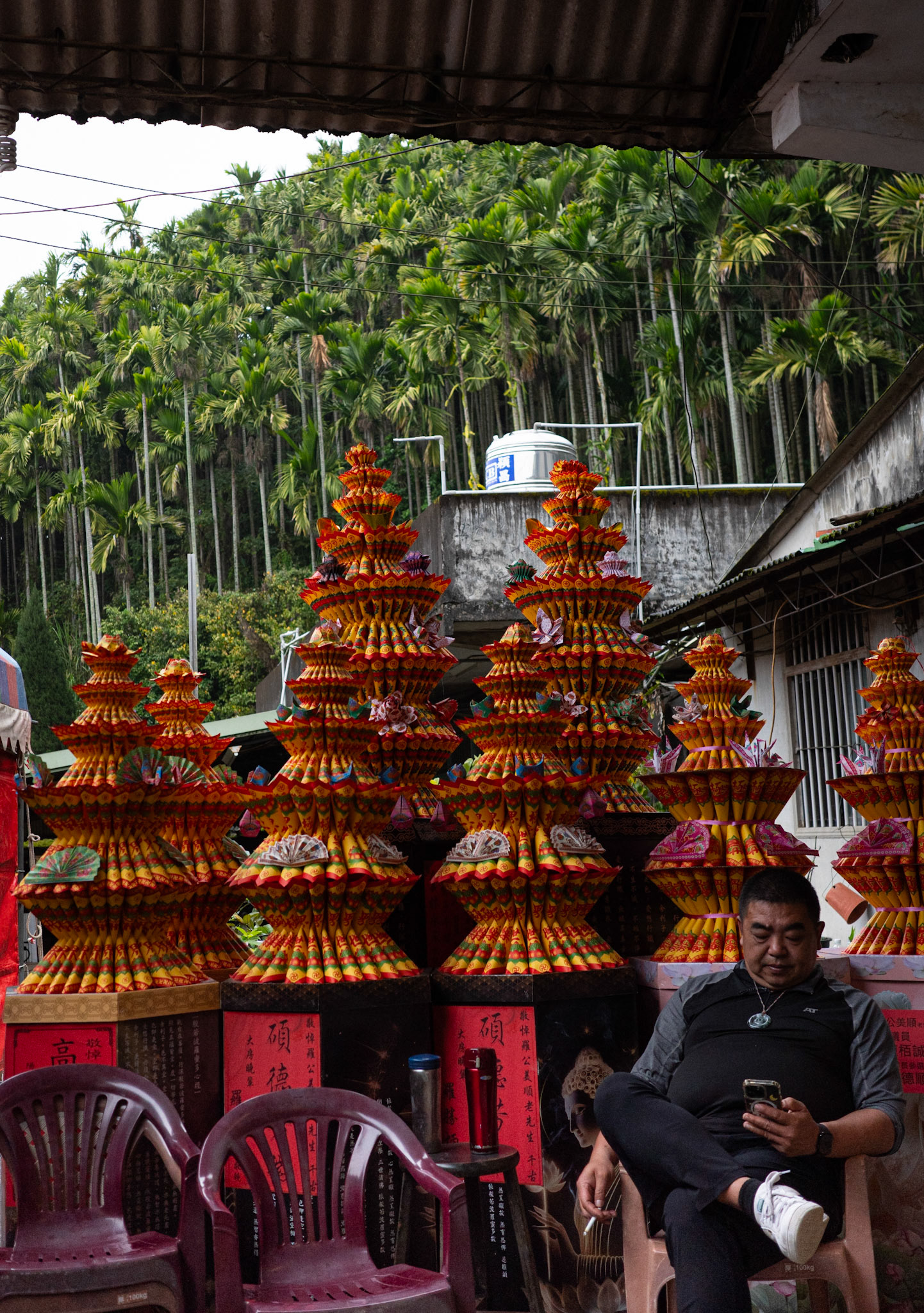
Legacy and Landscape
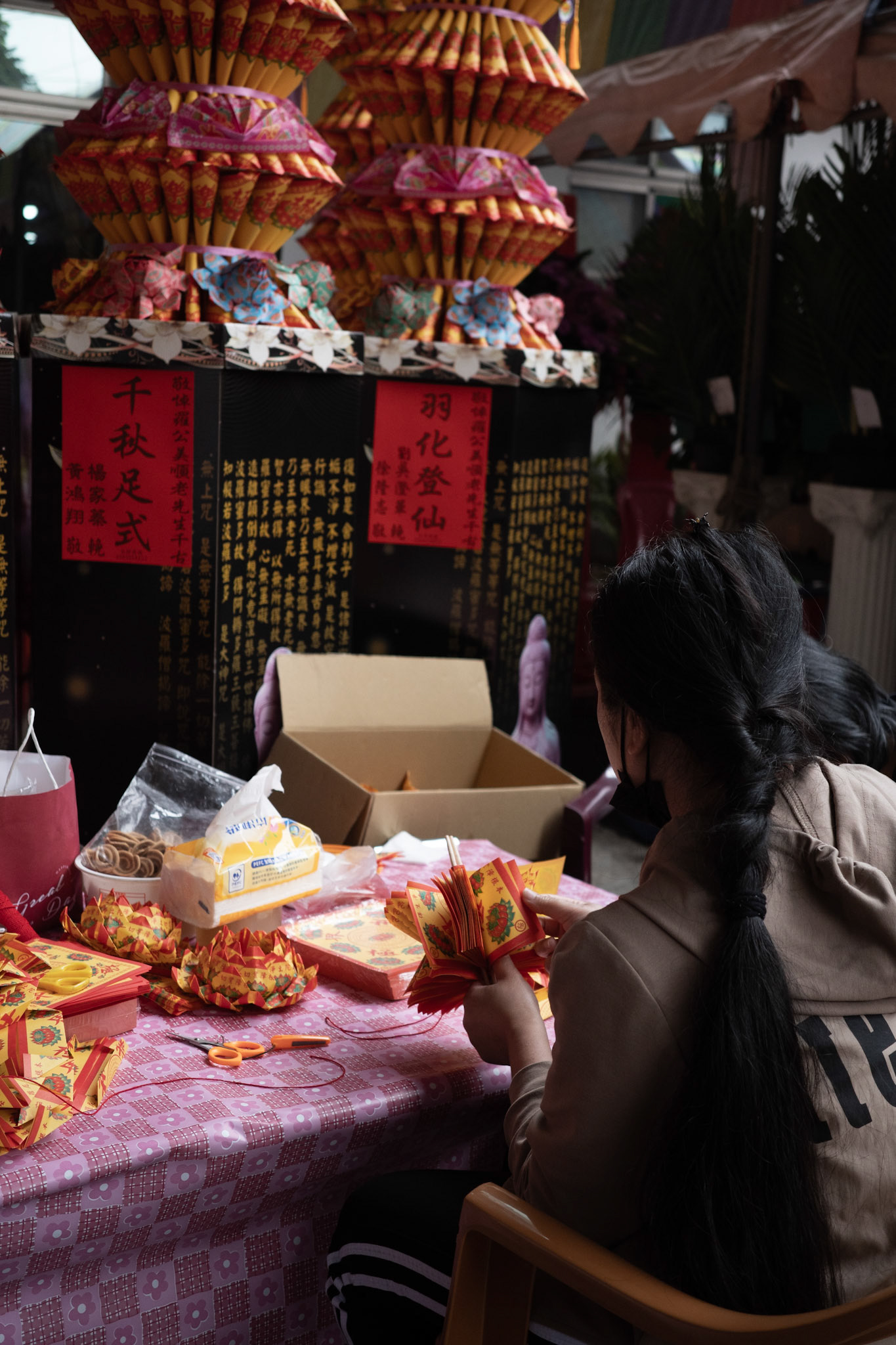
Folding Memories from Afar
[Legacy and Landscape]
In the courtyard of our ancestral home, during a break in the merit-making rituals, the eldest grandson takes a smoke break in front of paper lotus towers destined to be burned later that night as offerings. In traditional Taiwanese funerals, providing cigarettes is a customary gesture of hospitality, offering solace and an energy boost to guests during grueling vigils. Beyond the towers lies a lush grove of betel nut trees, planted by my grandfather in his youth to support the family. The ephemeral paper offerings contrast starkly with the enduring trees, illustrating the cycle of labor, legacy, and passing.
[長孫、蓮花塔與檳榔林]
靈堂外,在功德法事的空檔,長孫在即將於夜晚燒化的紙蓮花塔前抽菸小憩。在台灣傳統喪禮中,擺放香菸意在款待弔唁親友、慰藉守靈疲憊的民間習俗。畫面遠方是由外公年輕時栽種的檳榔樹林,作為家族的根基靜靜的看著整個家族壯大。紙紮祭品與生生不息的檳榔林形成對比,在長孫的守候下,述說著世代勞動與生命消長的循環。
[Folding Memories from Afar]
In a quiet corner of the venue, the Indonesian caregiver who tended to my grandfather until his final days sits silently folding paper lotuses. In Taoist tradition, folding these lotuses is a merit-making ritual typically performed by family members to guide the deceased to the Pure Land. This woman from another land, with no blood-ties to this event, still participates in the family's mourning through the most traditional of Taiwanese customs.
[摺疊思念的異鄉人]
在會場的另一角,陪伴外公走到人生盡頭的印尼籍看護正安靜地摺著紙蓮花,在道教信仰中,摺紙蓮花是家屬為亡者祈福、累積功德的傳統儀式。這位沒有血緣關係的異鄉人,以最道地的台灣方式參與著家族的哀悼,展現了在生命最後一哩路上,如同家人般深厚的陪伴與羈絆。
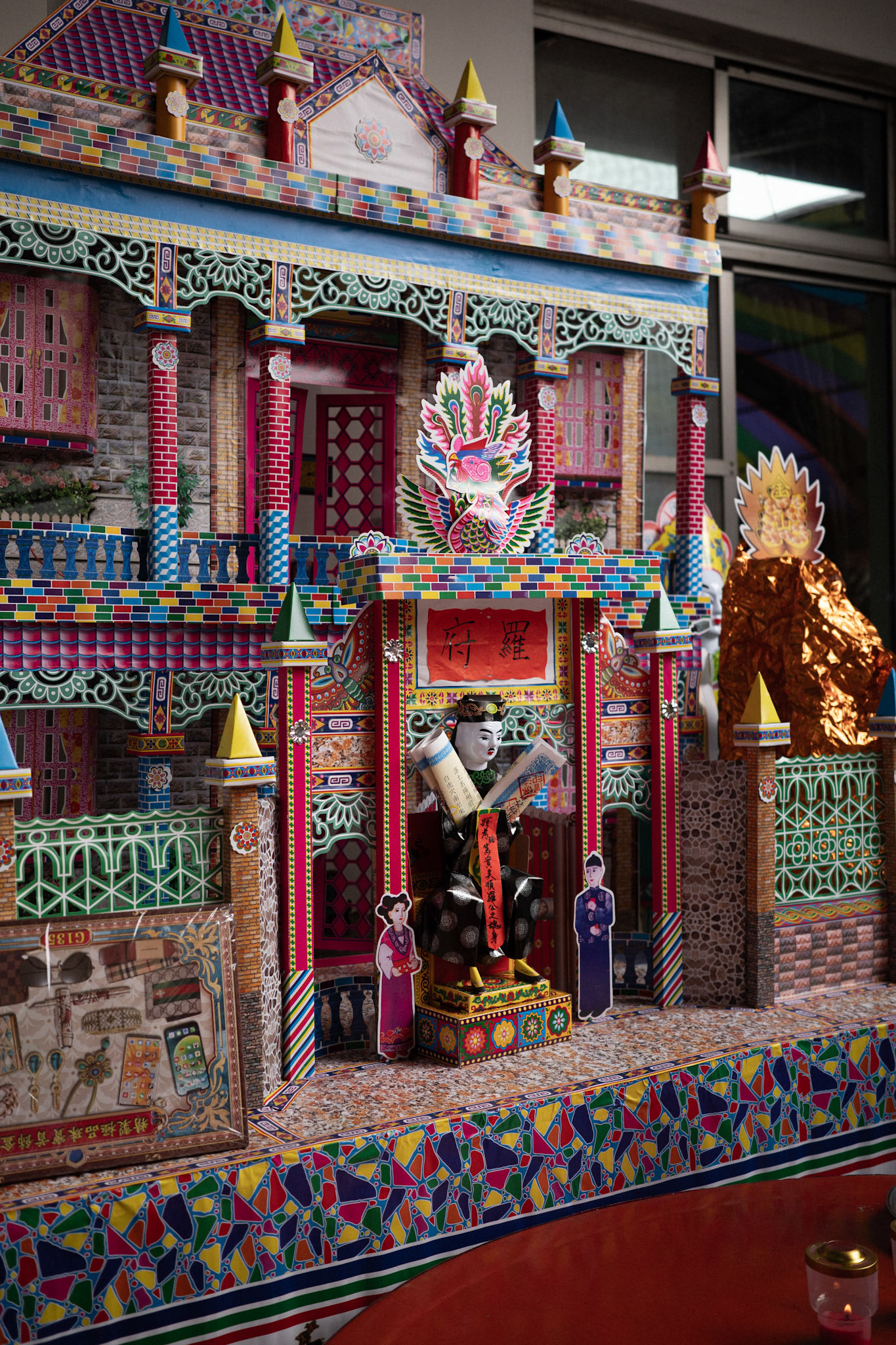
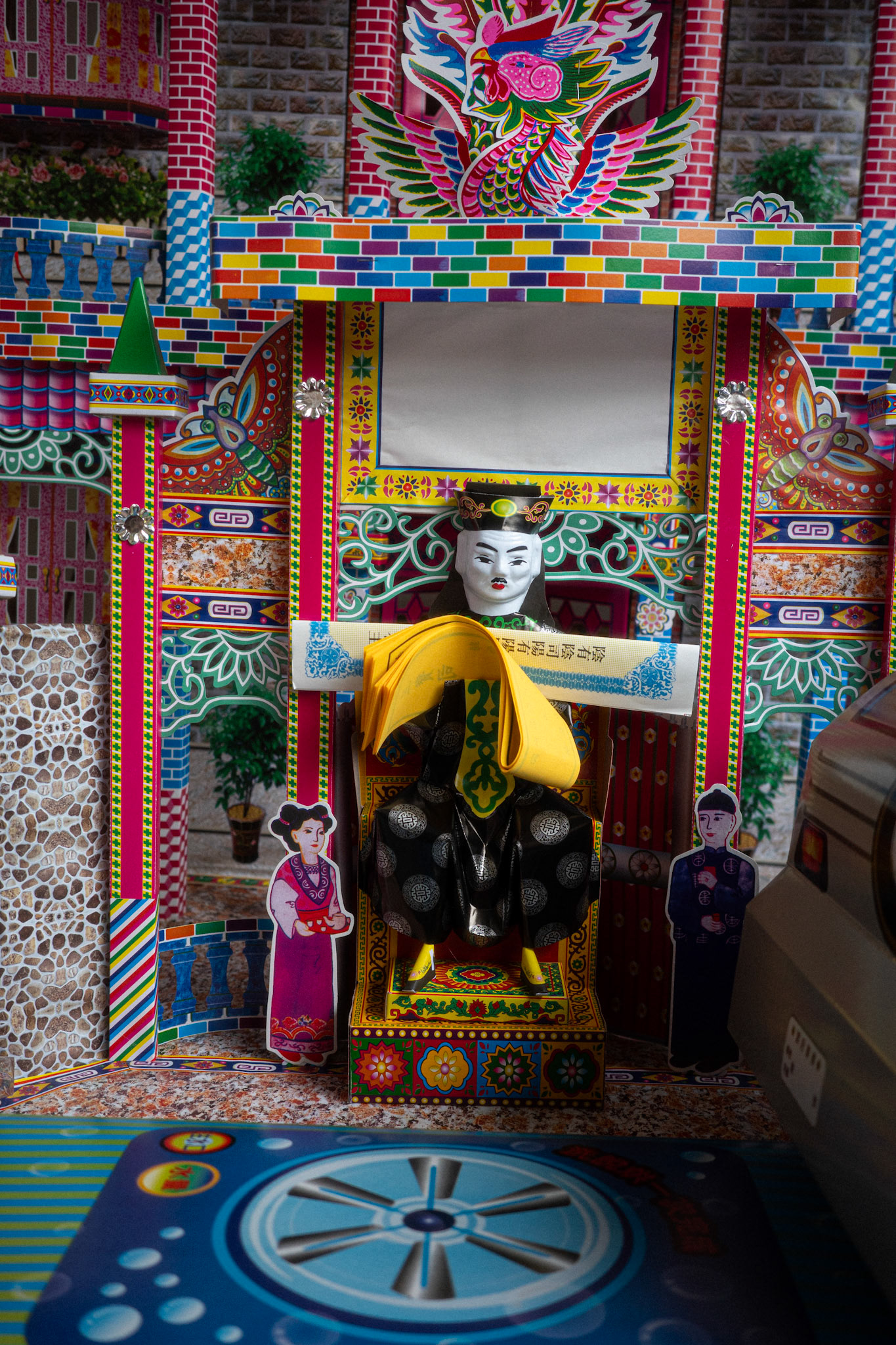
[Afterlife]
The Zhizha Mansion and the Spirit Deed In Taiwanese Taoist funeral rites, "Zhizha" (paper crafting) is the traditional art of constructing a dwelling for the deceased in the afterlife. Prepared for my centenarian grandfather, this intricate paper mansion uses highly saturated, almost surreal colors that pierce through the solemnity of the funeral, symbolizing a prosperous new existence. On the right, a paper steward guards the entrance holding a yellow "spirit deed." Once validated through Taoist rituals and burned, this document ensures the mansion is legally transferred to my grandfather in the spirit realm. From the grand architecture to the modern amenities neatly packed in the lower left corner, which even includes a paper smartphone, these elaborate crafts will ultimately be reduced to ashes. They serve as a physical manifestation of the living family's enduring love and meticulous care for the departed.
[紙紮豪宅與陰間地契]
在台灣道教喪葬儀式中,「紙紮(Zhizha)」是家屬為逝者構築來生居所的傳統工藝。這座為百歲外公準備的紙紮洋樓,以極度飽和、近乎超現實的色彩,打破了喪禮的沉重,象徵著對來世富足生活的祈願。畫面右側,鎮守大門的紙紮管家手中緊握著黃色的「陰間地契」,在經過道教儀式認證並焚化後,這份地契將確保外公在另一個世界合法擁有這棟宅邸。從氣派的建築結構到左下角細心準備的紙紮智慧型手機與現代生活配件,這些精緻的易碎品最終都將化為灰燼,但它們具象化了生者對逝者無微不至的牽掛與愛。
[Constructing the Sacred: The Dharma Altar and Religious Embroidery]
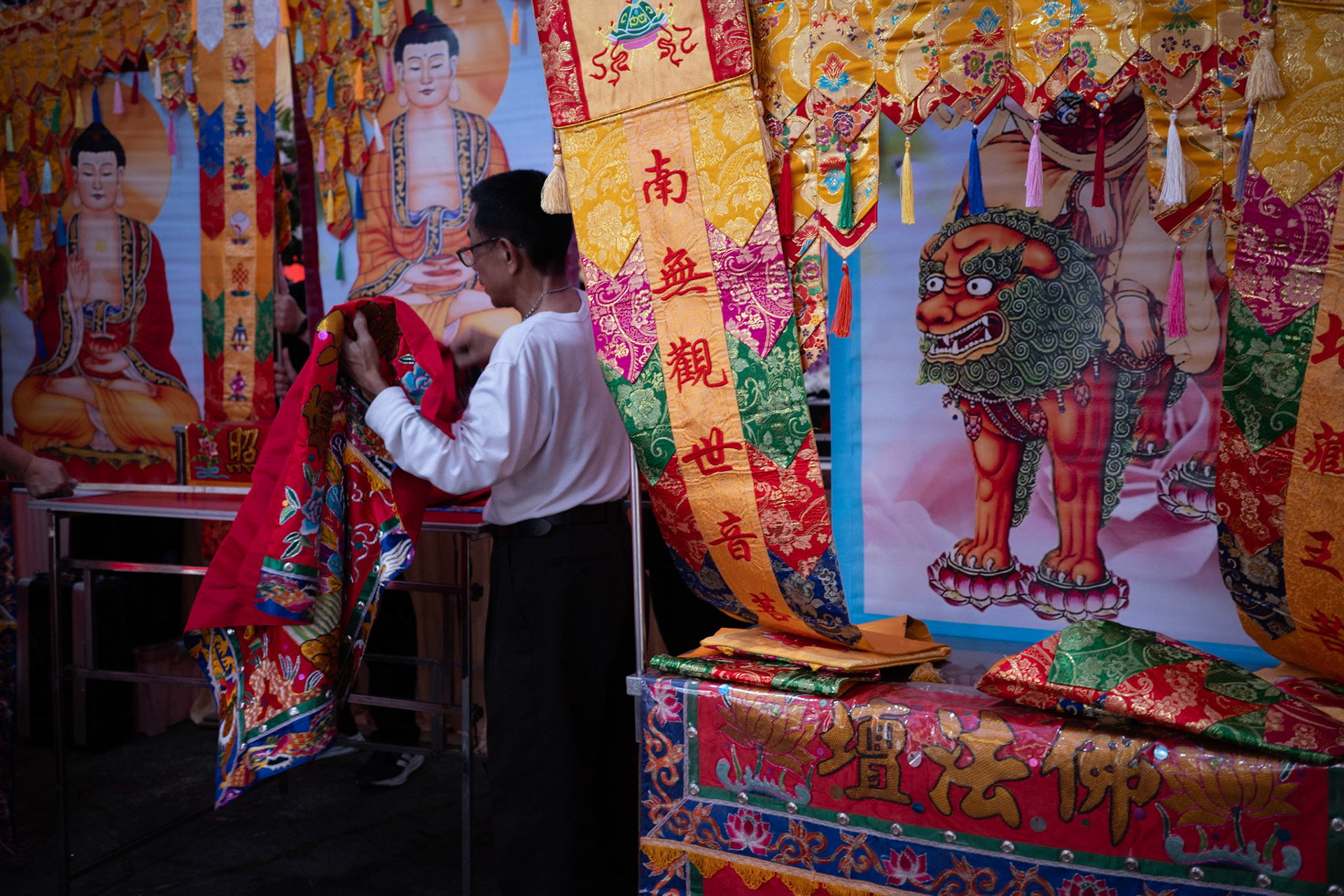
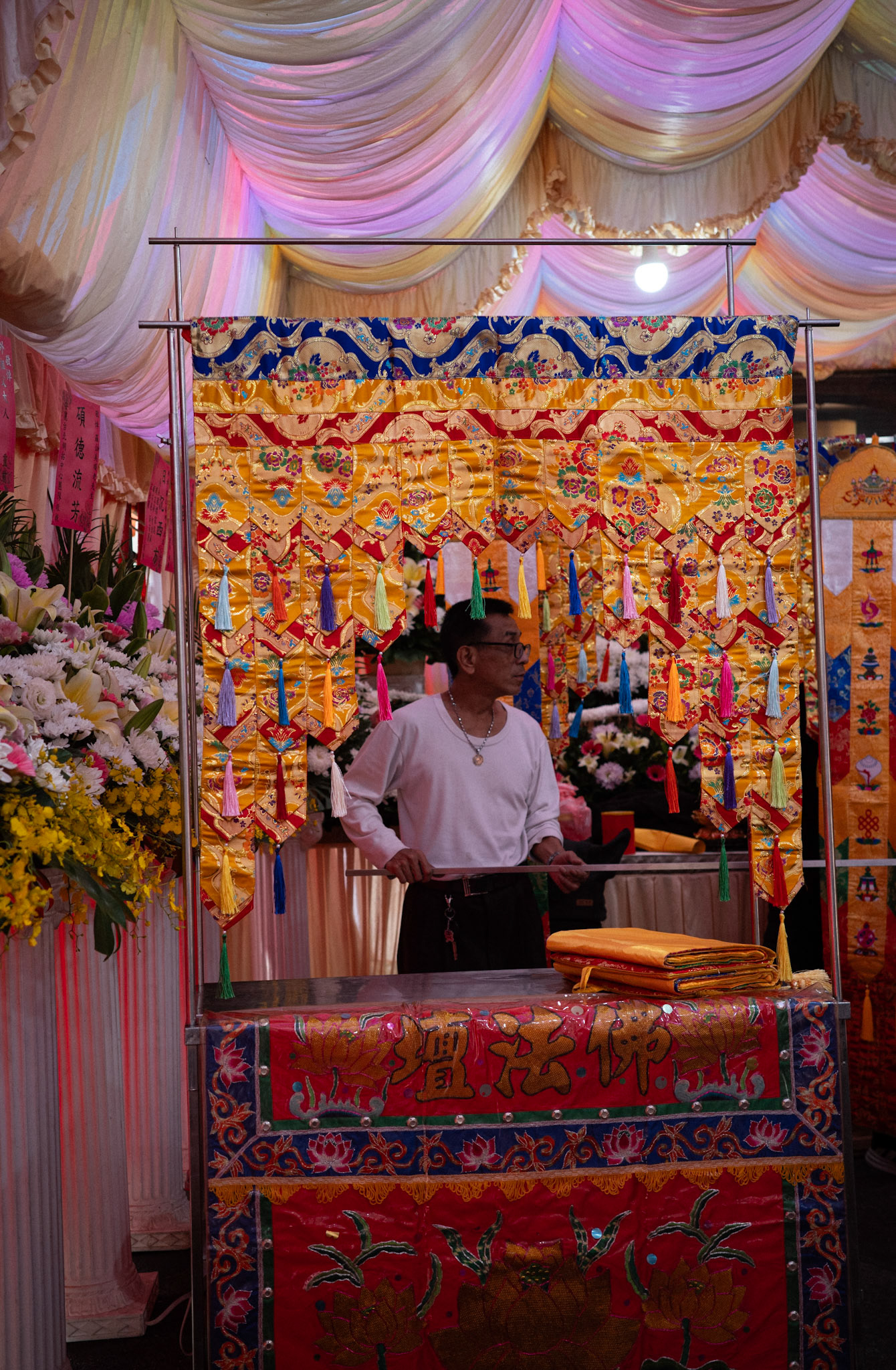
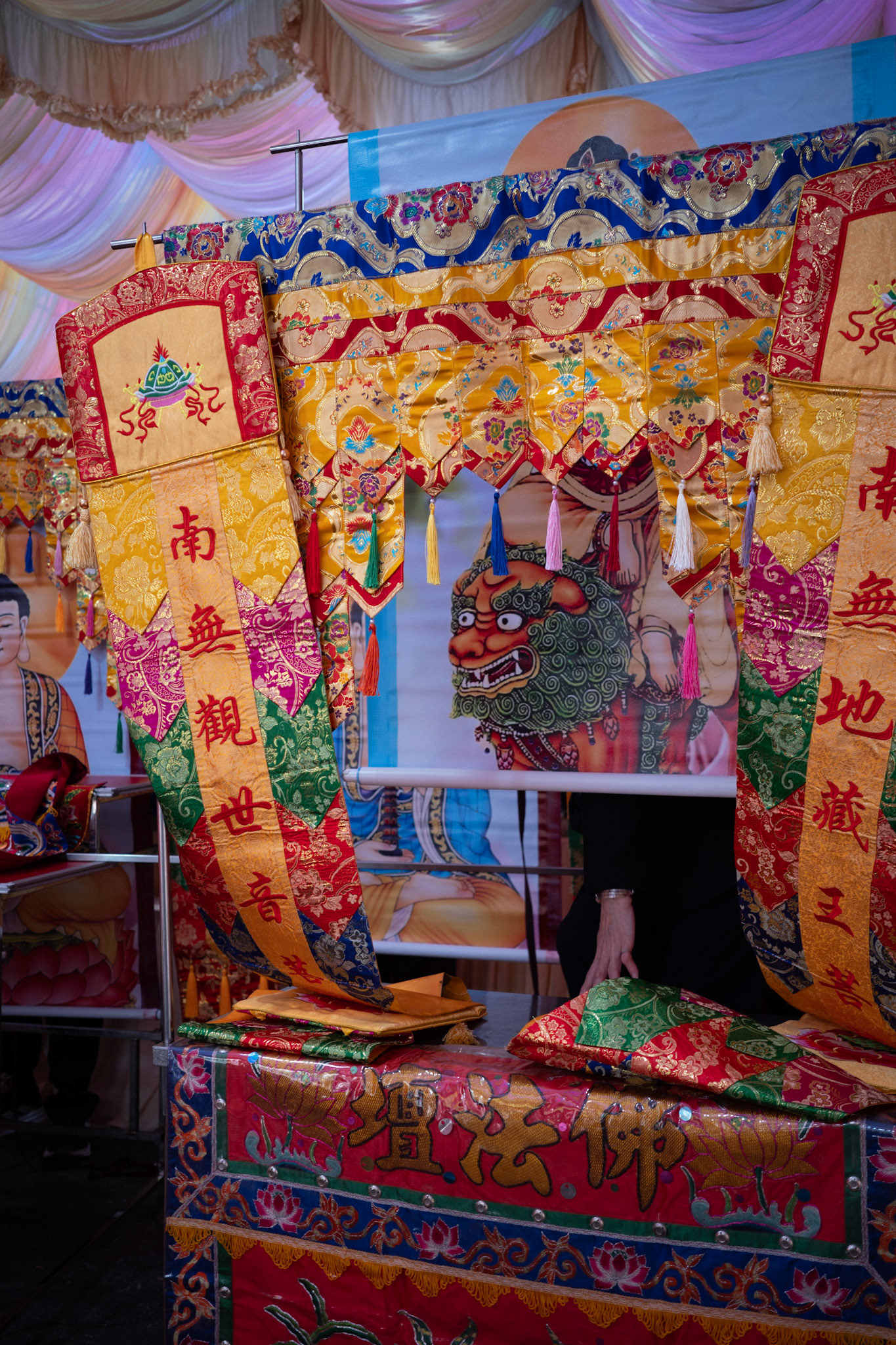
Before the sutra-chanting rituals commence, a ritual specialist meticulously sets up the "Dharma Altar" (佛法壇). Although the funeral follows traditional Hakka Taoist customs, Taiwanese folk religion is also highly involved. The embroidered banners invoke the names of Bodhisattvas like Guanyin (Goddess of Mercy) and Ksitigarbha (Lord of the Underworld), seeking their divine guidance for my grandfather’s journey to the Pure Land. This preparation is more than mere physical arrangement; it is the consecration of a sacred boundary within the secular funeral venue. The lens captures the maximalist aesthetics of traditional Taiwanese religious artistry: vibrant threads, shimmering gold accents, and layered tassels. All of these elements converge to elevate the grandeur of the final farewell.
[佛法壇與宗教刺繡美學]
在誦經超渡儀式開始前,法師正專注地搭建佛法壇。雖然告別式遵循客家道教傳統,但台灣民間信仰高度佛道融合,祭壇上高懸的幡帳寫著南無觀世音與地藏王菩薩的名號,祈請大慈大悲的神佛護佑外公前往極樂世界。台灣傳統宗教工藝中極致的繁複美學,鮮豔的繡線、閃耀的金彩與層疊的流蘇,這些強烈的視覺元素共同撐起了整場儀式的莊嚴肅穆。
[Guiding the Spirit: Taoist Rites and the Resonance of Hakka Bayin]
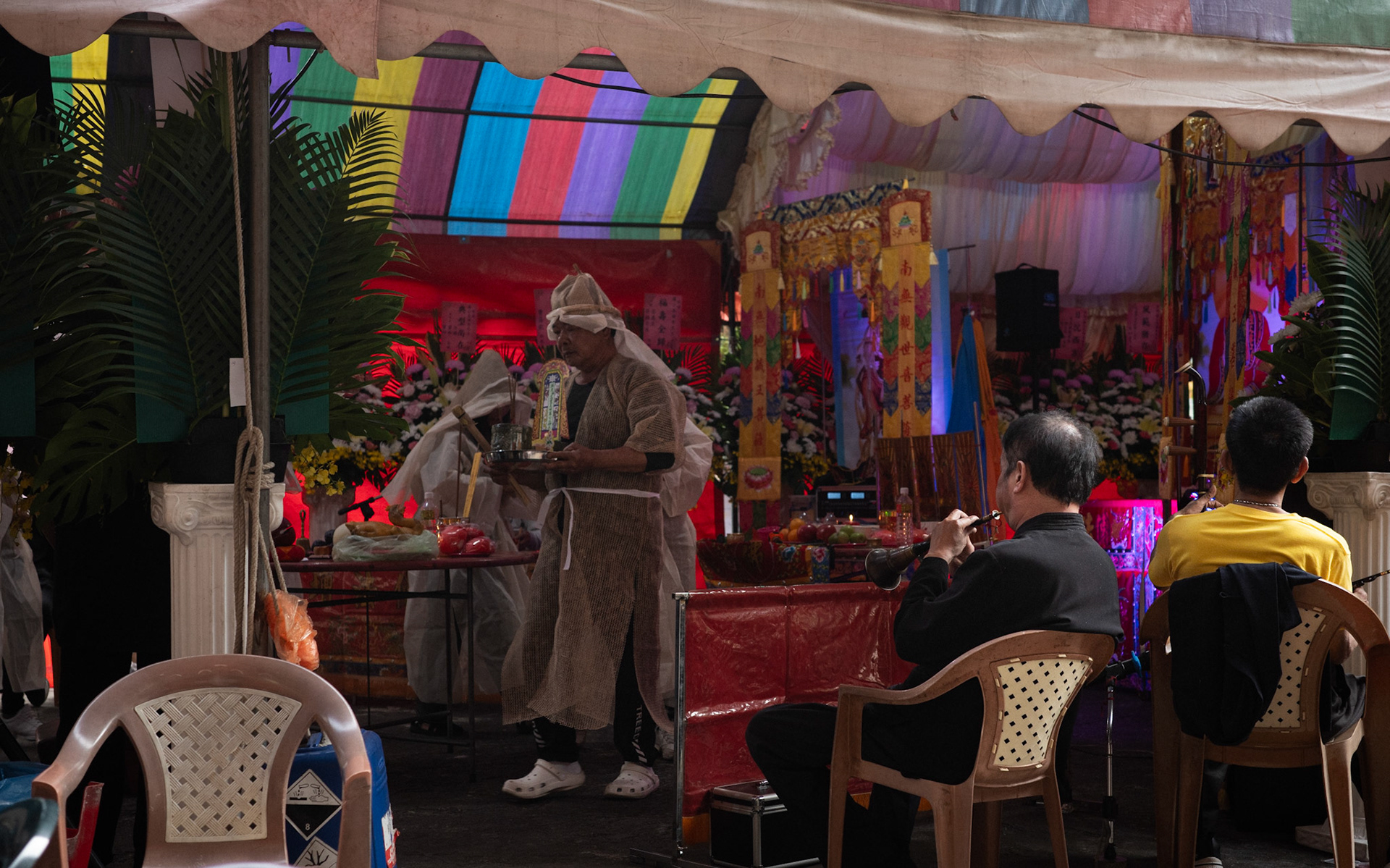
At 2:00 PM, the formal Taoist rites commence. Direct descendants, the children and eldest grandson, clad in white garments and coarse hemp tunics, dutifully follow the Taoist priest (DaoShi) to guide the departed soul. The chief mourner in the center wears the heaviest traditional mourning attire made of raw hemp (披麻戴孝), carrying the spirit tablet with profound reverence. To the right, musicians play traditional instruments, including the erhu and the suona (a double-reed horn), accompanied by the unseen clashing of gongs and drums. Together, they create the traditional Hakka funeral music known as Hakka Bayin.
This image captures the visceral energy of Taiwanese folk transitions: the grief of the living intersecting with vibrant ceremonial colors. It also captures a distinct auditory landscape. Unlike the soothing Chinese orchestra played during public memorials to comfort guests, the Hakka Bayin performed during these initial rites uses the unapologetic, piercing sounds of the suona to communicate with the heavens. It is not meant to be delicate; it is a powerful, resounding effort of the living to clear a path for the departed spirit.
Note: Insights into the cultural significance of Hakka Bayin were informed by Shaopeng’s "Hakka Bayin: A living cultural memory".
[引路:道教科儀與客家八音]
下午兩點,超渡儀式正式展開。身穿白衣的直系親屬(兒女與長孫)緊隨法師的步伐,進行引領亡魂的傳統科儀。畫面中央的主祭者身披禮制中最重的粗糙麻服(披麻戴孝),雙手恭敬地捧著牌位。在會場右側,樂師正吹奏著嗩吶與二胡,與未入鏡的鑼鼓聲交織成客家喪葬中特有的傳統樂音——客家八音。
在色彩強烈的搭棚下,生者承載著厚重的悲傷,與鮮豔的宗教視覺產生強烈對比。同時,它也凝結了獨特的聽覺地景,不同於公祭時用以撫慰賓客的柔和絲竹國樂,科儀中所演奏的客家八音,是以嗩吶高亢穿透的音色直達天聽。那不求優雅,而是生者為了替亡靈開路,所發出的最具力量的聲響。
註:關於客家八音的文化意涵,參考自 Shaopeng〈Hakka Bayin: A living cultural memory〉。
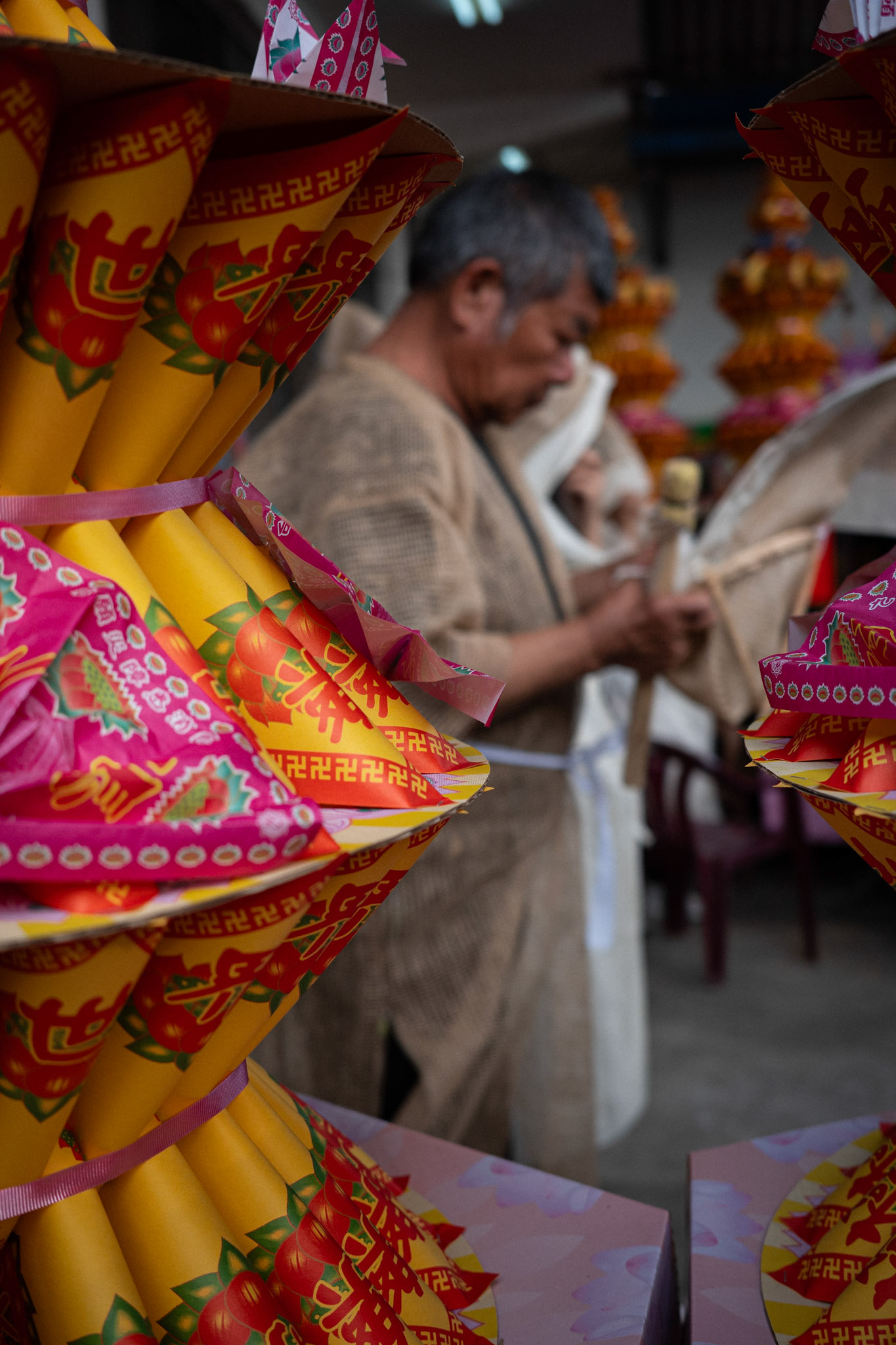
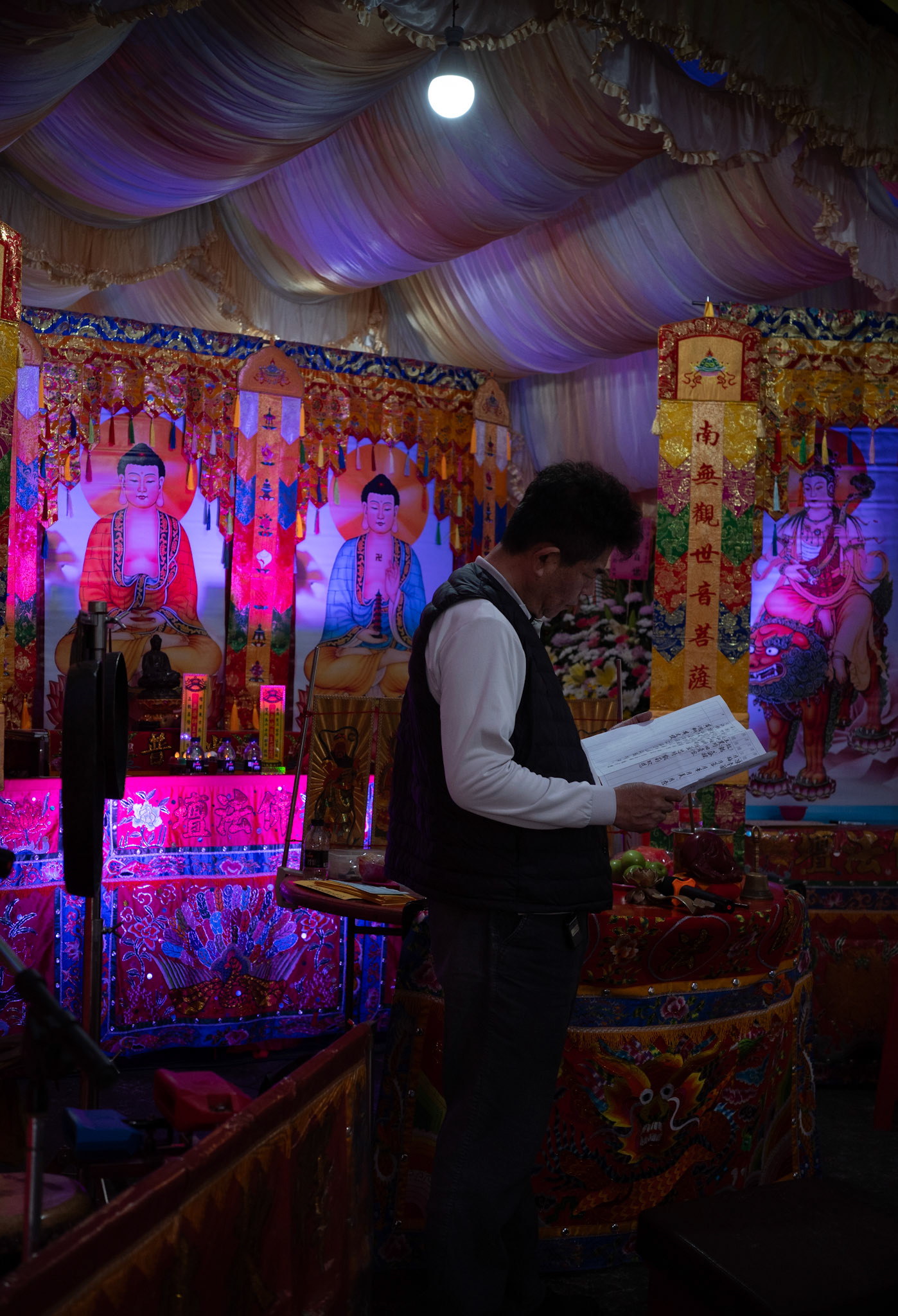
This two pictures capture the lesser-known, behind-the-scenes details of a traditional Hakka Taoist funeral. In the left image, viewed through the blurred foreground of stacked paper lotus towers, my uncle (the second-oldest son) adjusts his coarse hemp hat, the heaviest mourning attire as dictated by tradition (披麻戴孝), while he prepares to return to the exhaustive Taoist rites. The stacked paper lotuses symbolize the accumulation of merit, offering prayers for the deceased to be free from suffering and find eternal peace. The solemnity in his eyes reveals the duty and burden of a filial descendant. The right image depicts the spiritual guide of the ceremony. Beside an altar illuminated by neon light, the Taoist priest studies a detailed roster containing the names and generational ranks of all relatives, ensuring accuracy during the chanting invocations.
Together, these two photographs narrate a deeper truth: behind this long farewell lies a tapestry of life's continuation, woven from the physical and psychological adjustments of the living, alongside the administrative diligence of the spiritual guide.
這組照片捕捉了傳統客家道教告別式中,鮮為人知的幕後細節。左圖中,舅舅(外公的二兒子)在前景疊加的蓮花塔虛影窺視下,整理著禮制中最重的粗麻布帽(披麻戴孝),準備回到現場參與漫長耗時的道教科儀。疊加的紙蓮花象徵著積累無量功德,祈願亡者離苦得樂。眼神中的莊重,展現了盡孝者的承擔。右圖則轉向儀式的引領者。在映著霓虹燈的祭壇旁,法師正研讀著詳細的名單,包含了所有親屬的姓名與輩份,以確保唱誦時精確無誤。
在漫長而神聖的告別儀式背後,是由無數個生者的生理與心理調整,共同細膩交織而成的生命傳承。
[The Weight of Mourning: A Chairless Meal and the Twilight Wait]
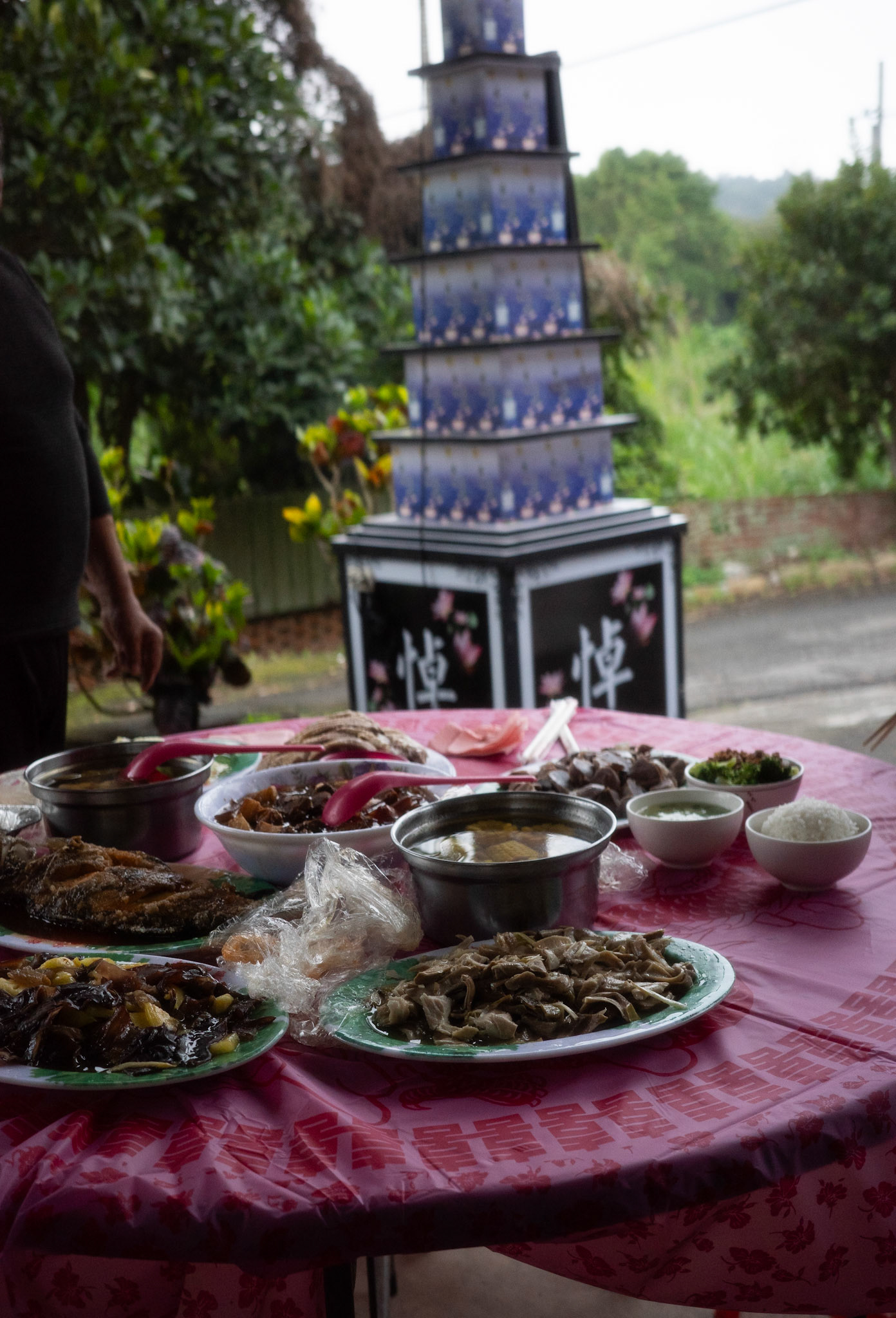
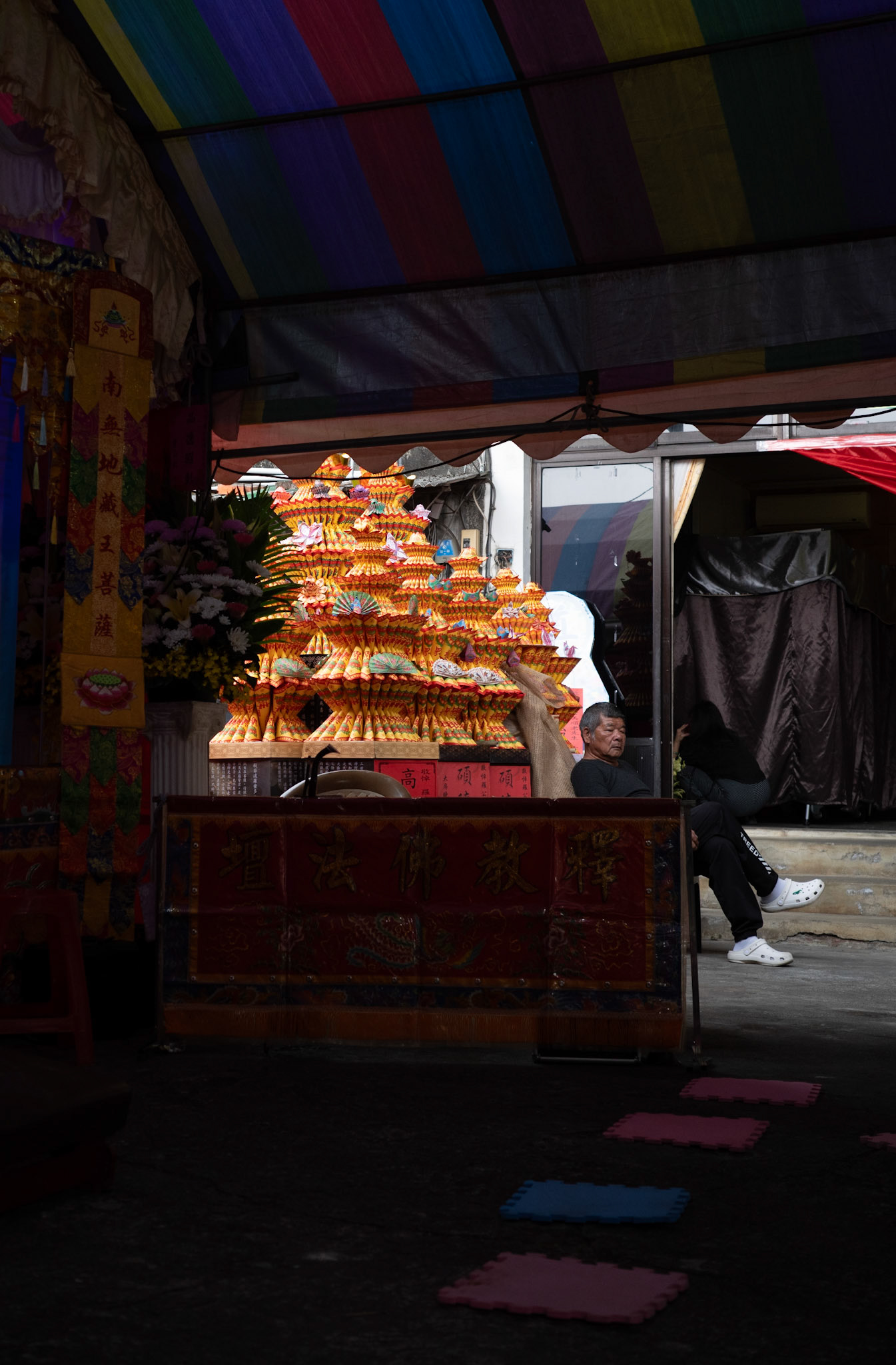
At 5:00 PM, the relentless pace of the funeral pauses for dinner, revealing a strict hierarchy of grief within traditional Hakka customs. Guest ritual masters and helpers are honored with the first meal at the table. In contrast, the immediate family must eat without chairs, often squatting or sitting on the ground, a physical manifestation of extreme sorrow and humility before the deceased. The right image depicts the quiet lull before the night's rites commence. Silhouetted against the paper lotus towers, a family member takes a smoke break in the shadows of the doorway. This brief interlude is not merely a physical rest, but a silent bracing for the demanding and exhaustive rituals that lie ahead.
[肉身的重量]
下午五點,告別式的節奏隨著晚餐暫歇,卻也顯露出傳統客家喪禮中嚴格的悲傷倫理。前來協助的法師與賓客被尊為上賓,得以上座先食;而身披重孝的家屬,為了表達失去至親的極度哀痛與謙卑,必須捨棄椅子,蹲踞或席地用餐。右圖為科儀開始前的真空時刻,家屬隱沒於暗處坐在門廊歇息,安靜的迎接夜晚更漫長、繁複的超渡儀式。
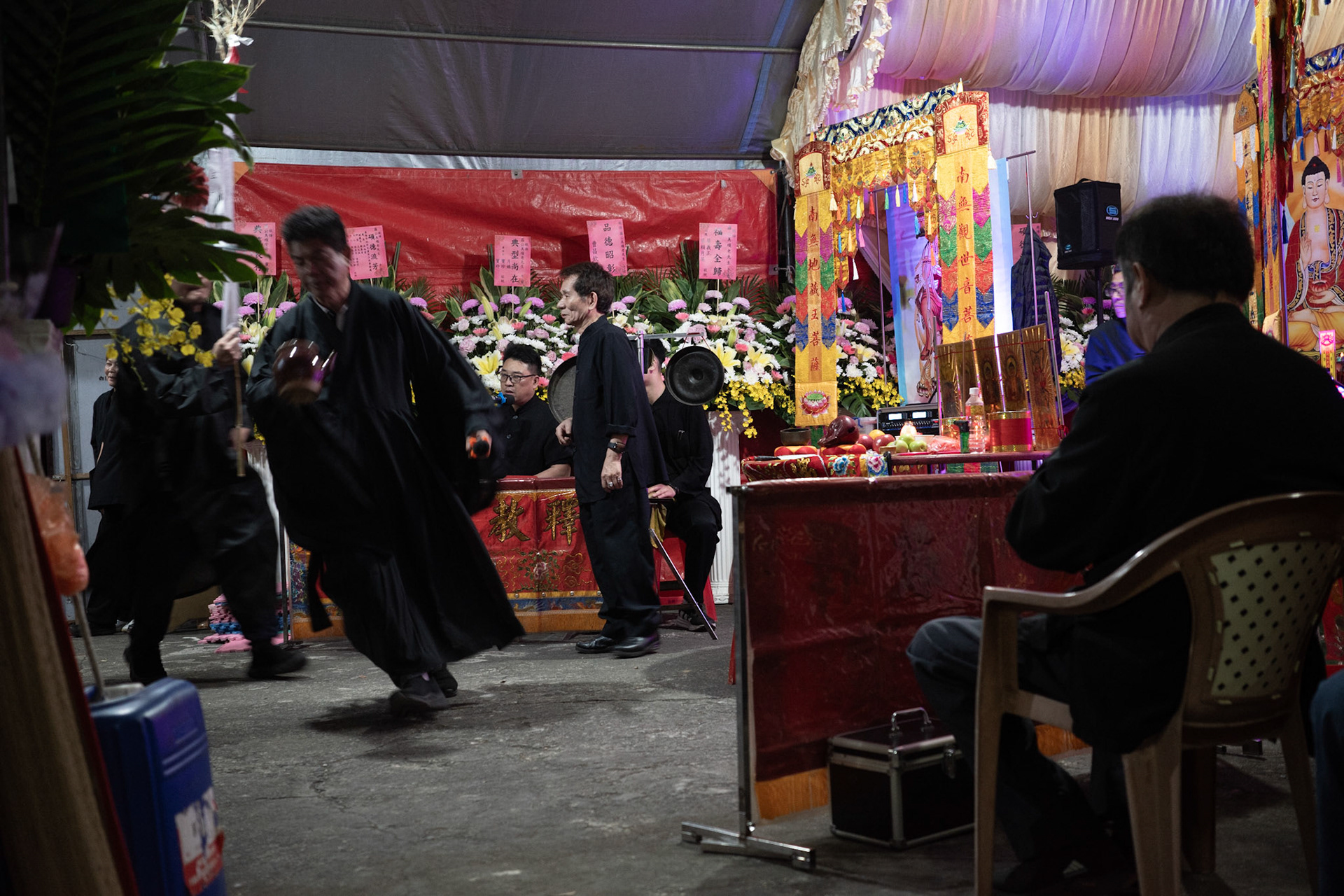
As night falls, the Taoist rites enter a highly physical and frantic phase. The priest calls out to the family: "I need six grandchildren who can run," before leading them in a rapid, continuous sprint in circles around the venue. In traditional customs, this ritual is often known as "Running the Pardon" (Zou She). The priest embodies a divine messenger riding a horse to the underworld, urgently delivering a heavenly pardon to absolve my centenarian grandfather of any unintentional earthly transgressions. Enlisting the young grandchildren to sprint closely behind is deeply symbolic: they lend their youthful stamina to this grueling spiritual journey. Their sweat, exhaustion, and heavy breathing serve as an expression of physical sacrifice to aid their ancestor. The motion blur in the photograph perfectly translates the raw urgency of this interdimensional rescue mission.
夜幕降臨,漫長的道教儀式進入了最耗費體力的動態環節。法師在祭壇前點名:「我需要能跑的,孫輩來六個。」隨即帶領著子孫在會場內急速繞圈狂奔。在傳統習俗中,這通常被稱為「走赦」(跑赦馬)。法師此刻化身為急遞天庭赦令的信使,騎著無形的快馬趕赴地府,為百歲外公滌除生前無意間積累的罪業。點名年輕孫輩緊隨其後,不僅是為了借用生者的體力來完成這趟艱辛的陰間旅途;子孫們在狂奔中流下的汗水與急促的喘息,更是傳統文化中「盡孝」最極致、最動態的肉身展現。
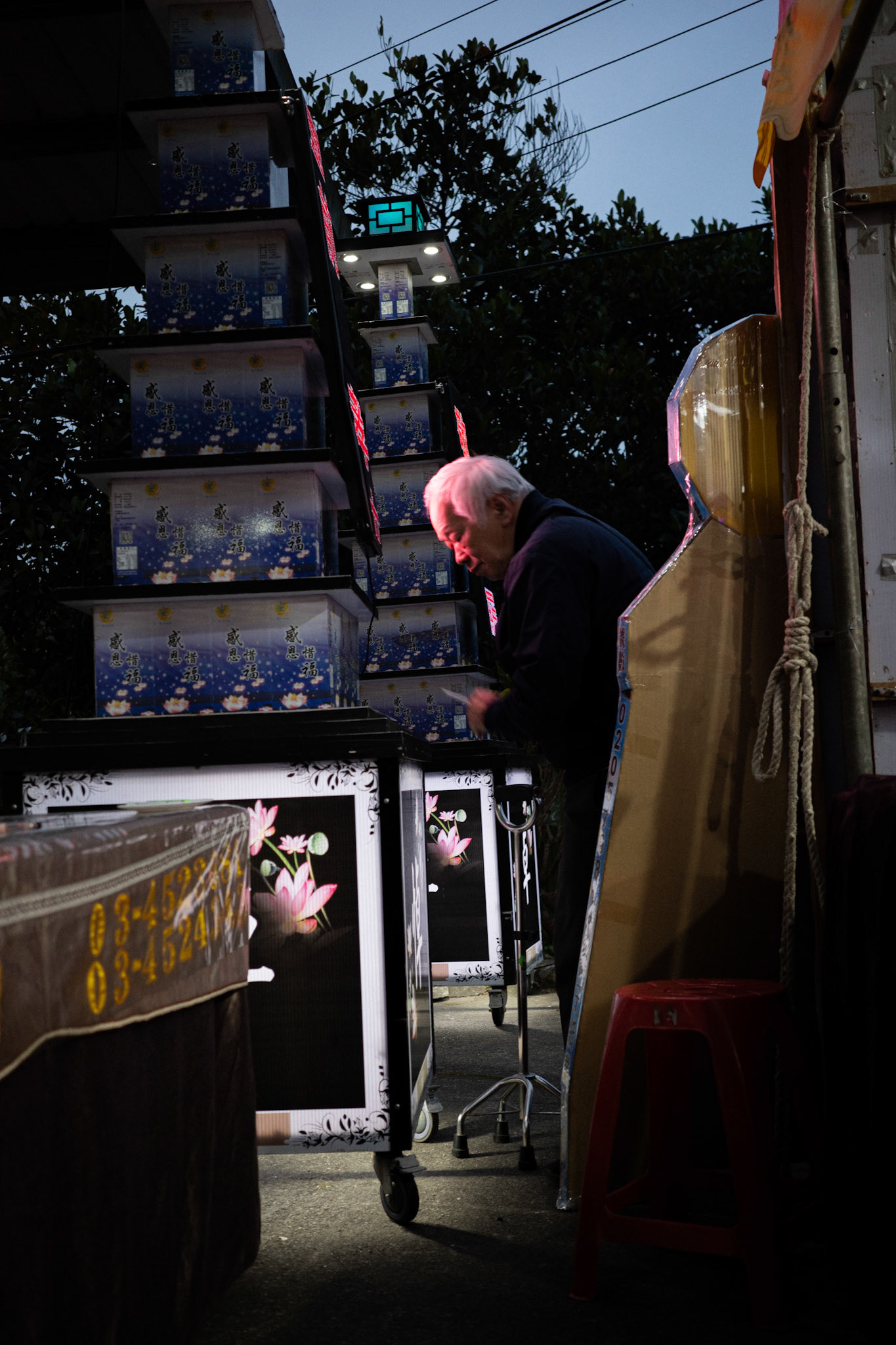
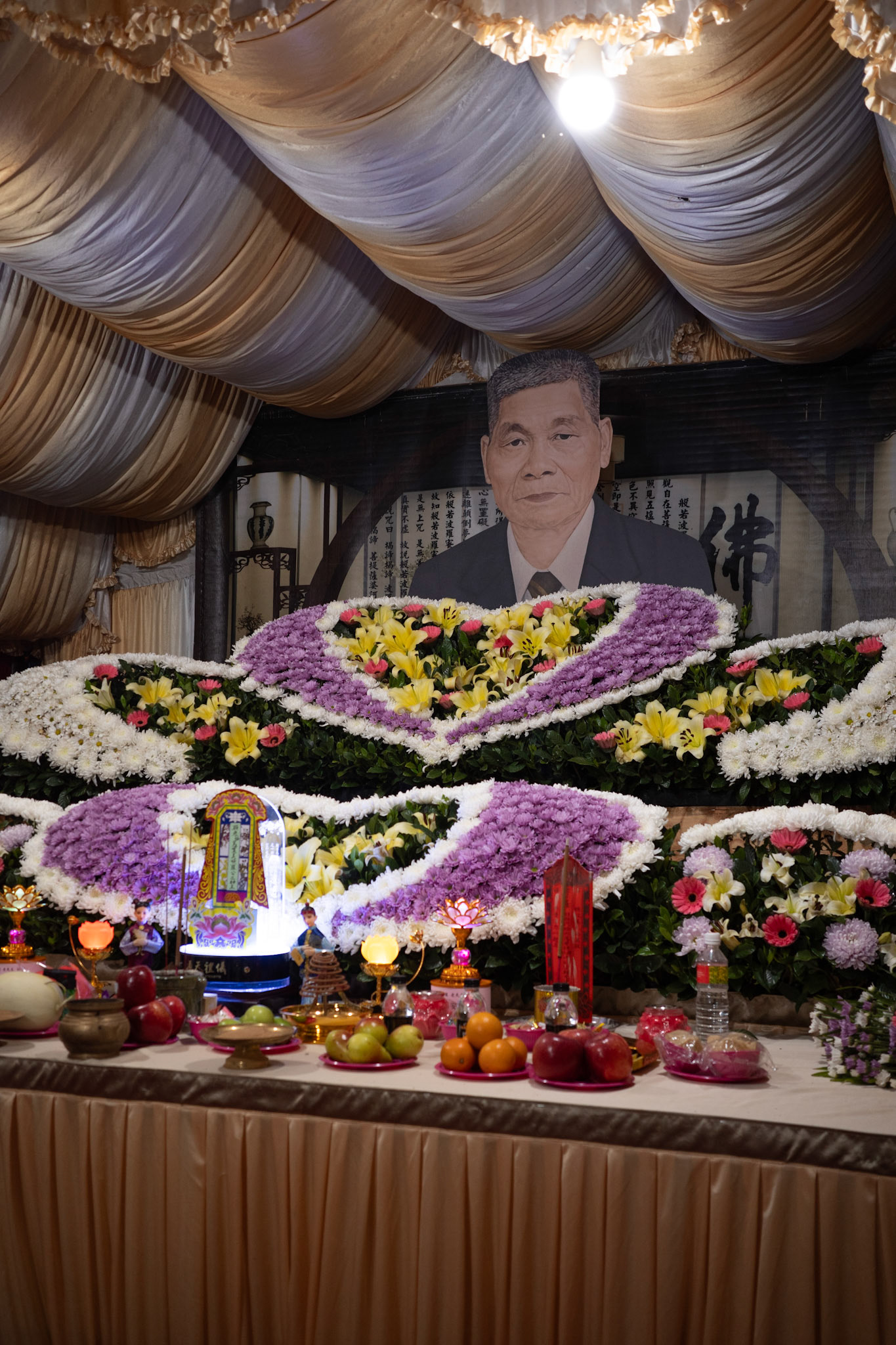
This set shifts the focus to my grandfather's character and personal connections. On the left, an elderly friend, relying on a four-legged cane, makes an effort to reach for a customary cigarette at the reception desk on the eve of the public memorial. The dim lighting and his frail silhouette speak volumes about the fading of a generation and the profound effort made to bid a final farewell to a peer. On the right is the main altar (靈臺). Notably, the memorial portrait nestled within the floral arrangement is not a conventional studio photograph. Instead, it is a painting by a talented mouth-and-foot artist my grandfather serendipitously met at Hukou Old Street. As his mobility declined in his later years, he forewent formal studio sessions, making this beloved artwork his chosen image to say goodbye to the world. This choice breaks traditional visual conventions, leaving a warm, personal imprint within the solemn ceremony.
左圖中,外公的高齡好友拄著四腳拐杖,步履蹣跚地在公祭前夕的招待處拿取香菸。昏暗的光線與他衰老的背影,訴說著同代人逐漸凋零的孤寂,以及堅持前來送別的深厚情誼。右圖則是告別式的主祭壇(靈臺)。特別的是,花海中央的遺像並非傳統照相館拍攝的制式相片,而是外公生前在湖口老街偶遇一位口足畫家為他繪製的肖像畫。隨著晚年行動逐漸不便,外公未曾再拍攝正式相片,這幅他生前最喜愛的畫作,便成了他向這個世界告別的最終面貌。這不僅打破了傳統喪禮的視覺慣例,更在莊嚴的儀式中,留下了一抹充滿溫度的個人印記與生命交會的感動。
[The Huaku Ritual]
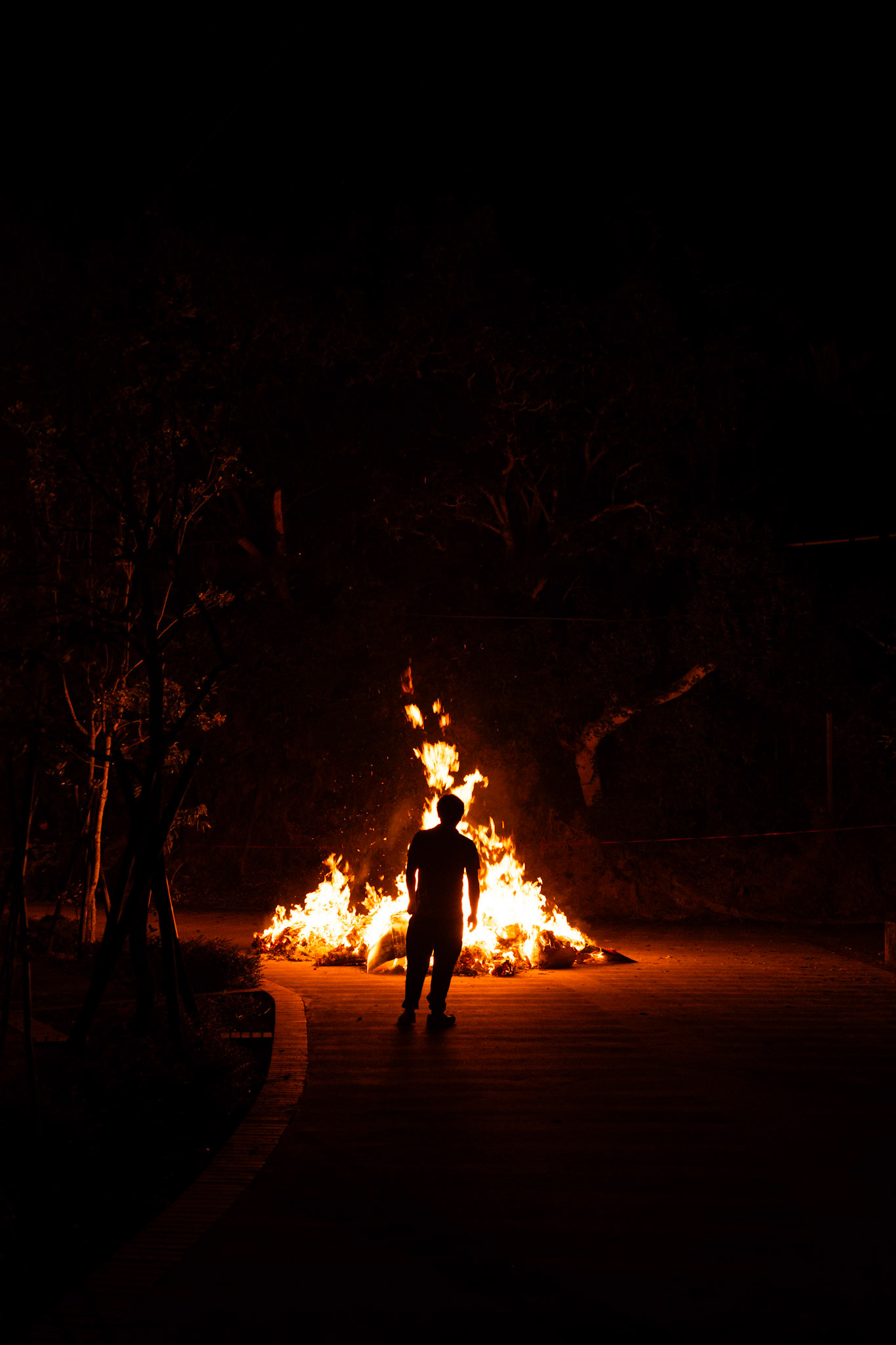
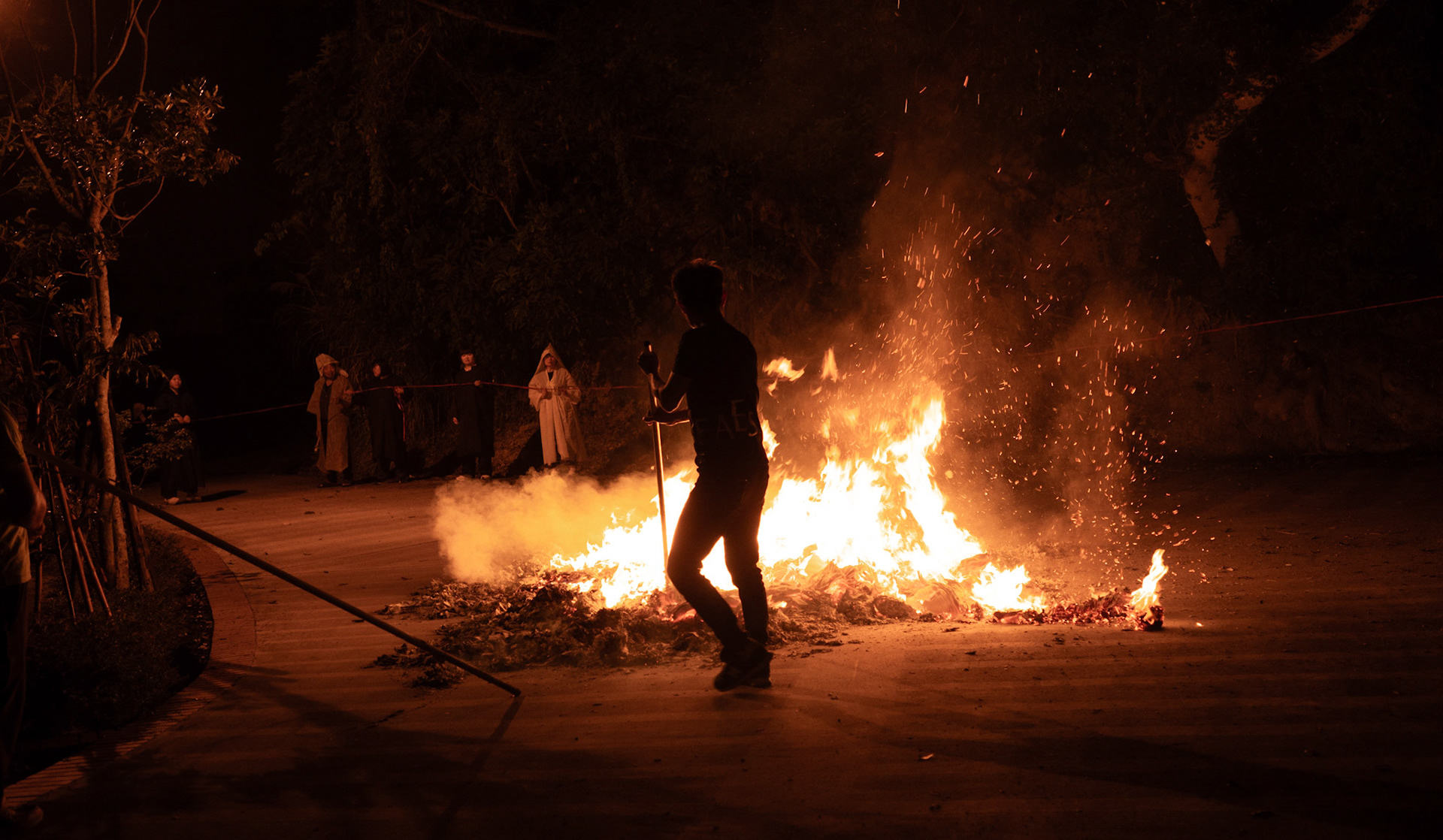
Deep into the night, the funeral reaches the "Huaku" (化庫) ritual, the transmutation of physical offerings into spiritual blessings. In an open clearing, paper lotus towers, the Zhizha mansion, and spirit money are consumed by a roaring fire, sent as provisions for the afterlife. Encircling the inferno, the family holds up taut a long red cord. This cord, which must not be broken or touch the ground, acts as a sacred boundary in Taoist belief, warding off wandering spirits from stealing my grandfather’s offerings. Amidst the flames, the family calls out in their native Hailu Hakka dialect: "Agong! Kuai loi liang gim ngin coi bo, oi shiu do o!" (Grandpa! Come quickly to claim your treasures, make sure you receive them!). The fire illuminates both the night and the living's fierce protection of the departed. Upon completion, the priest collects a portion of the ashes, symbolizing the successful delivery of the offerings and the preservation of the ancestor’s blessings for the descendants.
[化庫儀式]
深夜,告別式進入了將實體祭品轉換為無形祝福的化庫儀式。在空地上,紙蓮花、紙紮豪宅與無數的金銀財寶被熊熊烈火吞噬,化作送往另一個世界的供養。圍繞著火場,家屬們緊拉著一條紅線,這條不能落地、不能斷開的紅線,在道教信仰中形成了一道神聖的結界,防止孤魂野鬼搶奪給外公的供品。在火光中,家屬以海陸腔客語大聲呼喊:「阿公!快來領金銀財寶,愛收兜喔!」(阿公,趕快來領金銀財寶,要收到喔)。火光照亮了黑夜,也照亮了生者對亡者最後的牽掛與護衛。儀式圓滿後,法師會取下部分灰燼,象徵著這份跨越維度的供養已確實送達,並將先人的餘額福氣留存。
喜喪
[Branching Out: Attiring for the Public Memorial and the Family Tree]
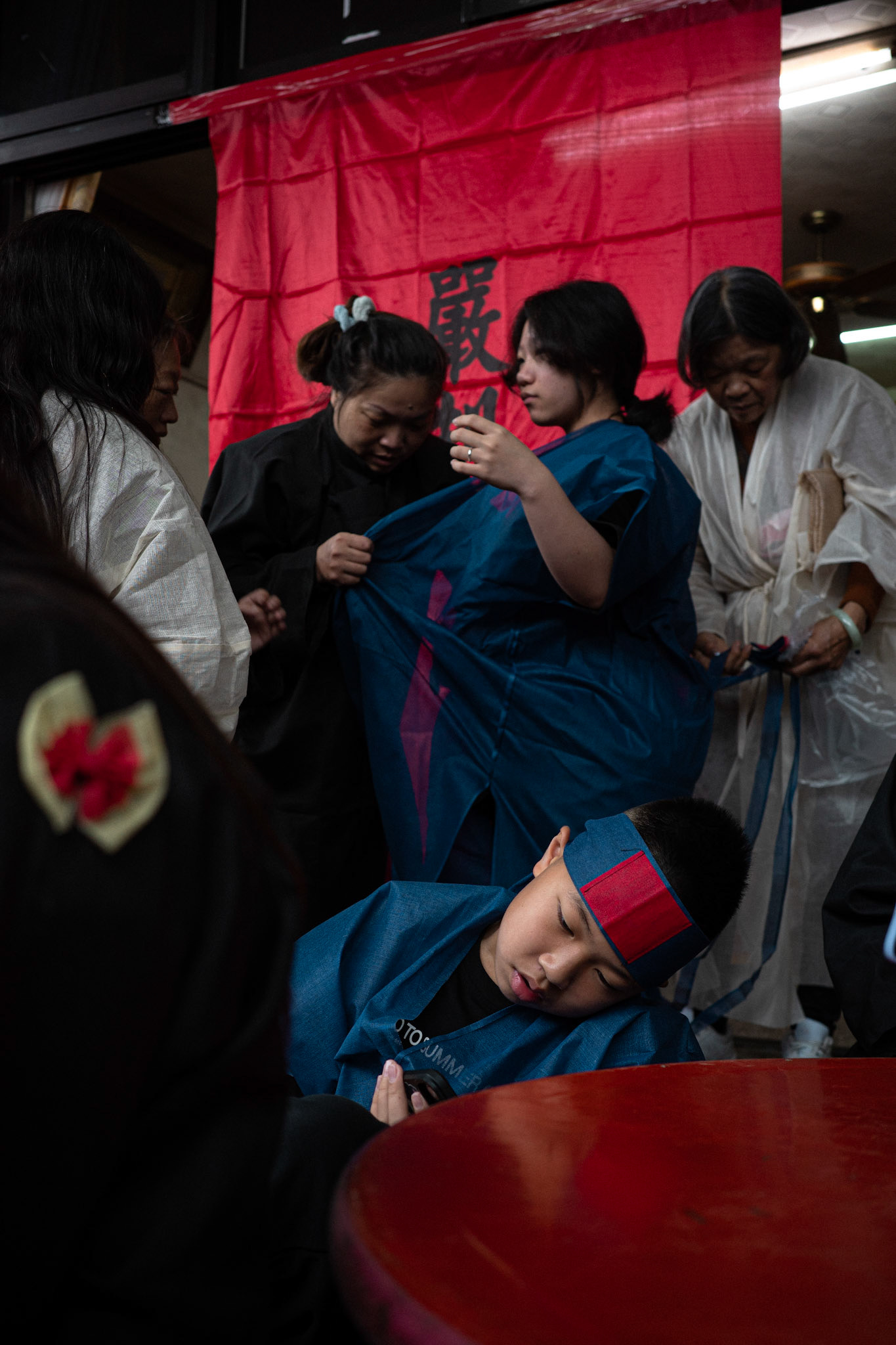
On the morning of the second day, ahead of the public memorial, the venue fills with the fourth generation: great-grandchildren donning blue mourning garments. Within the traditional Hakka mourning system, the color of the attire signifies the generational hierarchy: white for children, black for grandchildren, and blue for great-grandchildren. The young boy in the lower right wears a blue headband adorned with a red patch, a symbol of blessing in an auspicious funeral honoring a centenarian. My grandfather raised seven children, cultivating a family tree so sprawling that the Master of Ceremonies couldn't help but remark, "There are too many descendants; the venue might be too crowded." This logistical concern is, in truth, the highest praise for a long, fruitful life. The days-long traditional rituals are exhausting, as evident in the resting great-grandson, yet through the intimate act of helping one another dress, the family tenderly solidifies kinship bonds that span four generations, physicalizing their tight-knit connection during this long goodbye.
[開枝散葉:跨越四代的溫柔]
第二天早晨,隨著公祭即將展開,會場湧入了身披藍袍的第四代曾孫輩。在傳統客家喪服體系中,服飾的顏色清晰界定了家族輩份(白衣為兒女、黑衣為孫輩、藍衣為曾孫輩)。右下角的男孩繫著藍色頭巾,上面綴有一塊象徵百歲「喜喪」福氣的紅布。外公生前育有七名子女,開枝散葉後的龐大家族,讓負責引導的司儀都不禁感嘆:「子孫太多了,會場可能會很擠。」這句看似苦惱的日常對話,實則是對外公福壽雙全最美好的讚頌。傳統儀式令人疲憊,但家族成員在互相整理衣冠的過程中,也溫柔地凝聚了跨越四代的親族連帶,將這場漫長告別中緊密的情感具象化了。
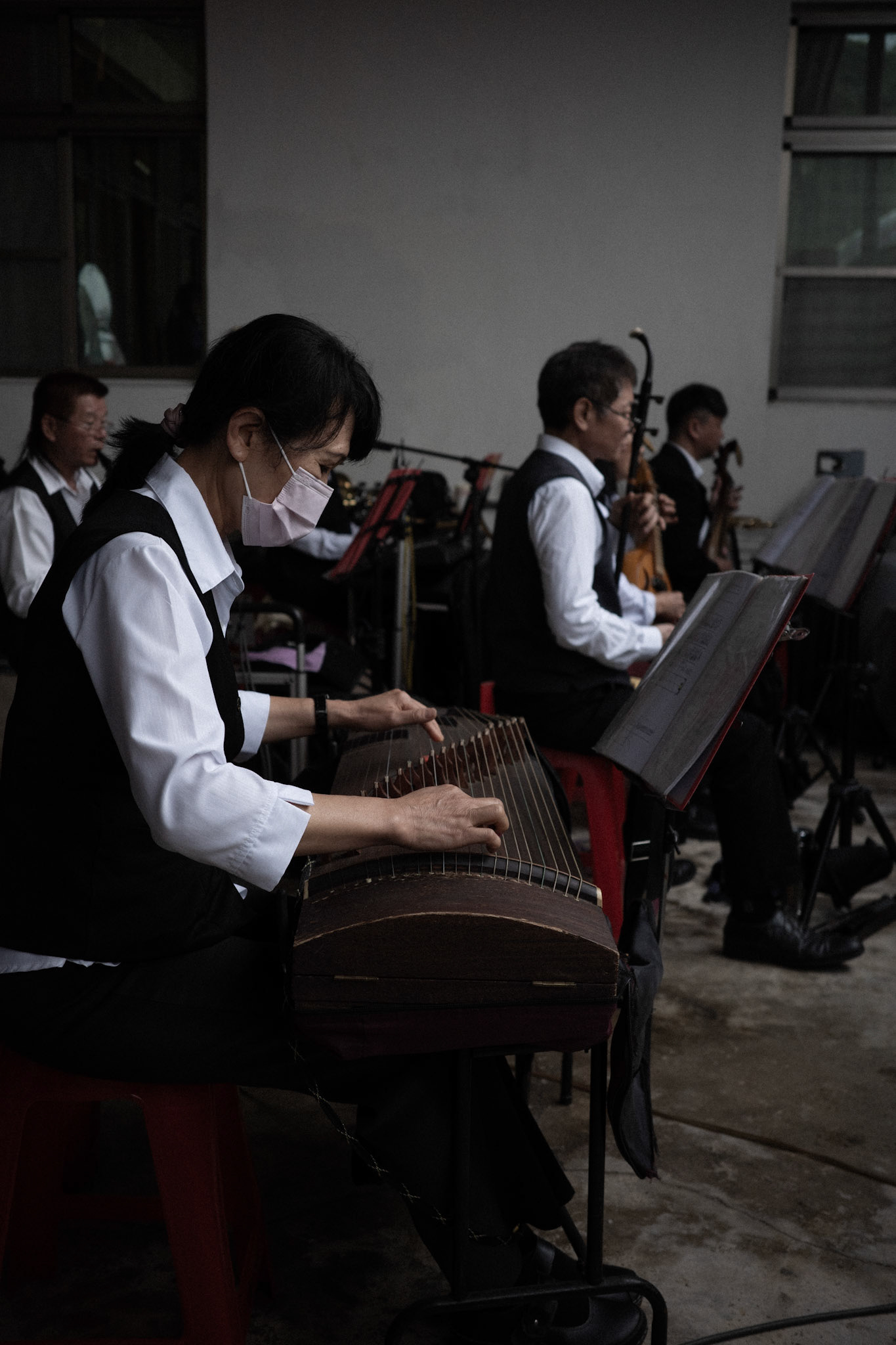
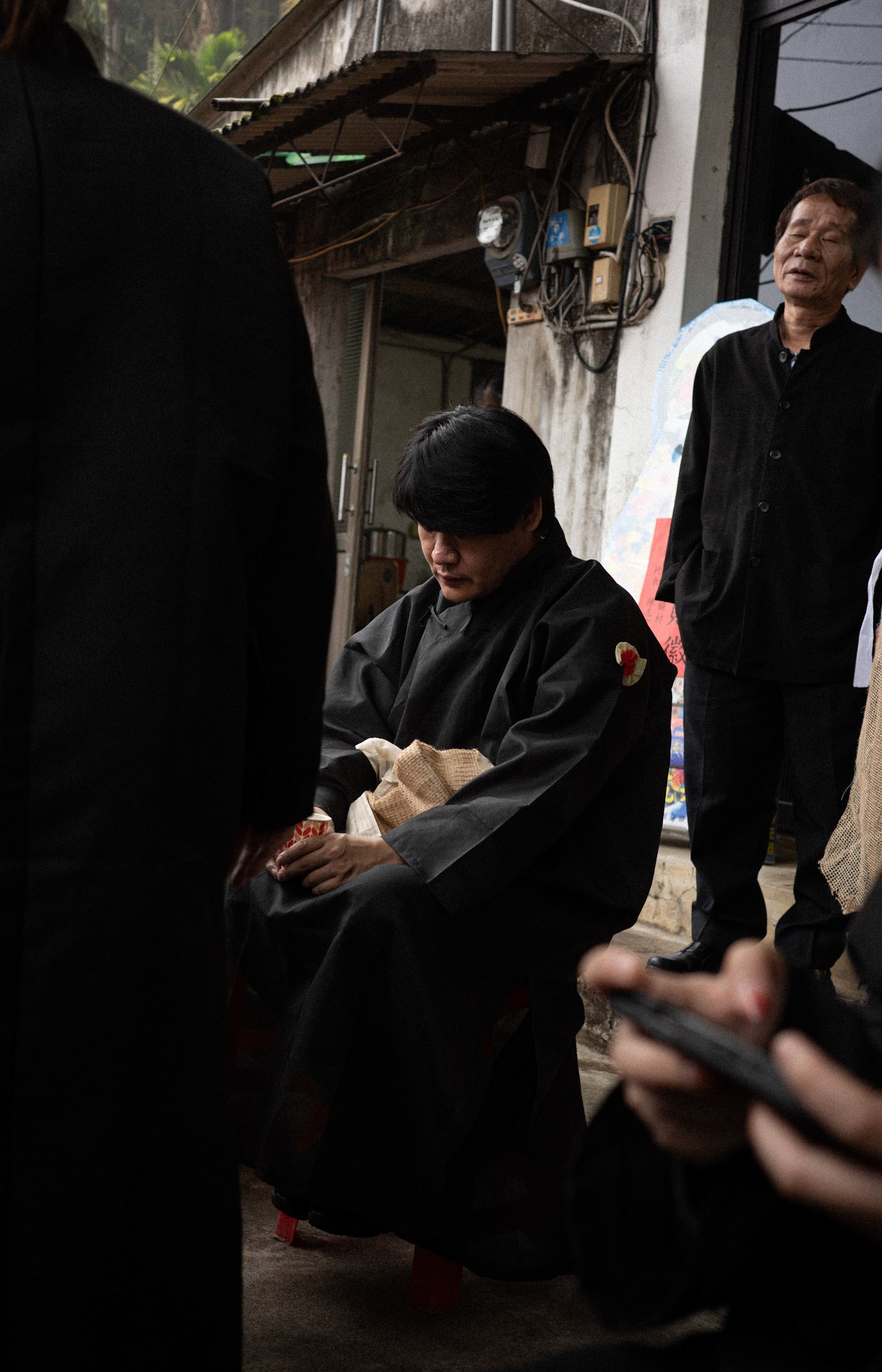
This set reveals the nature of the funeral as it transitions into the public memorial phase (公祭). The left image features a traditional "Silk and Bamboo" Chinese orchestra. Unlike the raw, piercing "Hakka Bayin" played on the first day which was meant to communicate with the heavens, this ensemble is a modern Taiwanese funeral addition designed specifically for the living. It features instruments like the guzheng (zither), erhu (fiddle), and ruan (lute). Its purpose is to create a solemn, elegant, and peaceful auditory landscape to comfort visiting guests and mourning families. Yet, despite the soothing melodies, the physical and emotional toll of the days-long rituals is undeniable. In the right image, my cousin rests exhaustedly in a corner. Dressed in a black mourning robe signifying the grandchild generation, with a red patch on his sleeve denoting the centenarian’s auspicious passing, his slumped posture and downcast eyes present a stark contrast to the formal performance on the left. Together, they capture the reality of a long goodbye: the public presentation of grace juxtaposed with the private, heavy weight of grief and fatigue.
這組照片呈現了告別式進入「公祭」(對外開放弔唁)階段的雙重面貌。左圖是負責演奏的傳統絲竹國樂團。不同於第一天直達天聽的「客家八音」,公祭時聘請編制包含古箏、二胡與小阮的國樂團,是現代台灣喪葬中專為生者設計的環節。其目的是以優雅、平靜的樂音營造莊嚴肅穆的氛圍,撫慰前來致意的外賓與家屬。然而,即便有柔和的樂聲安撫,長達數日的儀式依然是對肉身極大的消耗。右圖中,身穿黑色孝服(代表孫輩)的表哥在會場一角疲憊地歇息。他手臂上別著象徵百歲喜喪的紅布標,低垂的雙眼與沉重的身軀,與左圖端莊的演奏形成了強烈的對比。
[Final Words]
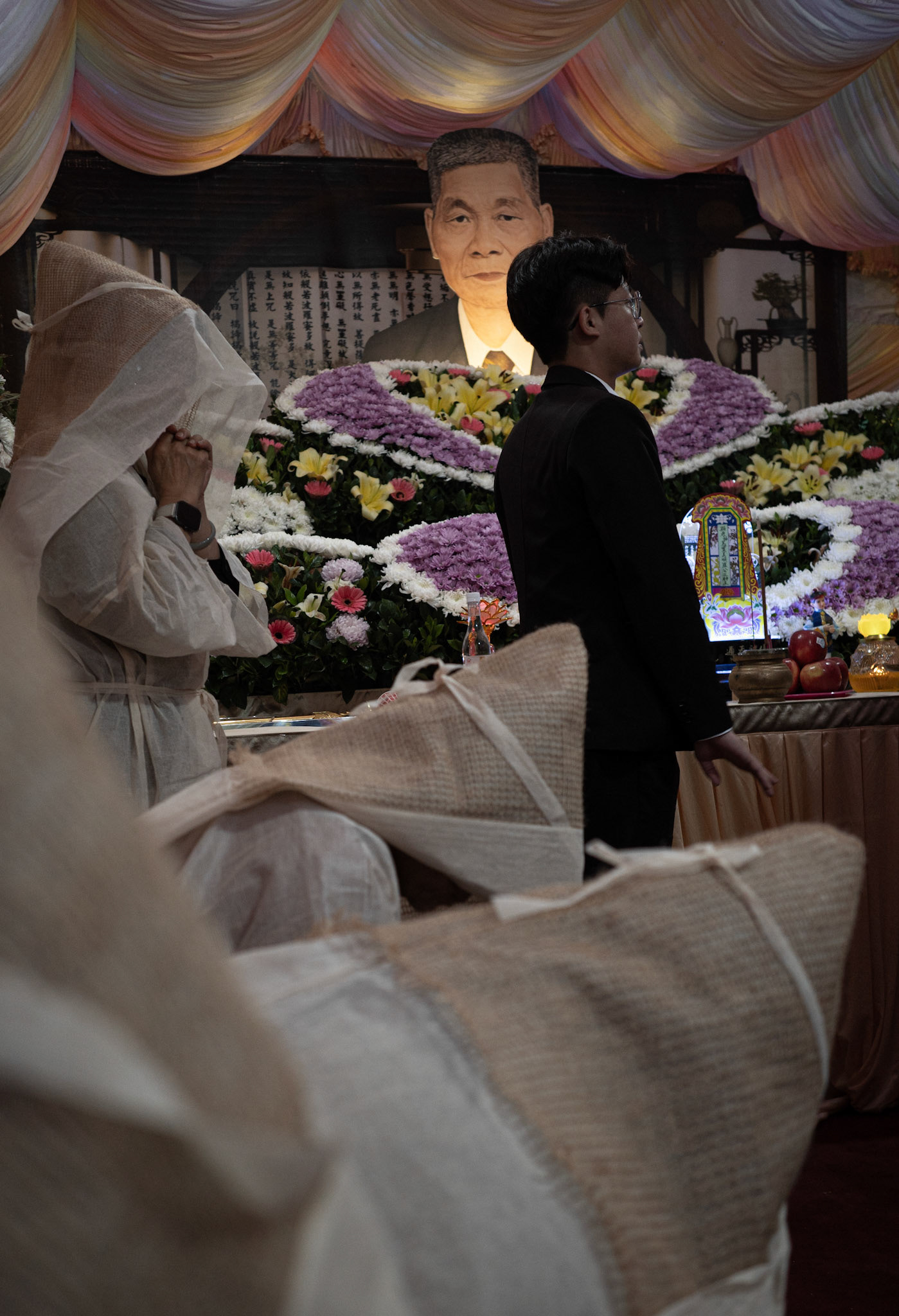
Before the doors open for the public memorial, the deeply private "Family Memorial" (家祭) takes place. In the foreground, daughters dressed in traditional white mourning robes and coarse hemp hoods kneel in deep reverence. At this moment, the Master of Ceremonies reads a eulogy on their behalf. Eschewing grandiose rhetoric, the eulogy reflects the pragmatic, grounded love typical of Taiwanese families: "Dad, you worked hard your whole life to raise us. When you reach the Pure Land, please don't be frugal anymore; buy whatever you desire." To the right stands a "Li Sheng" (Ritual Attendant), a modern funeral professional in a black suit and white gloves. His stylized hand gestures gracefully direct the rhythm of the bows and serve as a respectful acknowledgment on behalf of the deceased. This photograph layers three elements: the ancient, heavy grief of the kneeling family; the calm, professional structure of modern funeral rites; and the serene portrait of my grandfather in the background, receiving his descendants' final farewell.
[最後的叮嚀]
在對外開放的公祭之前,告別式會先進行專屬於家族內部的家祭。畫面中,身披厚重麻布蓋頭與白袍的女兒們,在靈前深深跪拜。此時,司儀正代表兒女朗讀著追思文。字裡行間沒有華麗的辭藻,而是台灣常民最樸實深切的親情叮嚀:「爸爸,您一生含辛茹苦,到了西方極樂世界別再省了,想買什麼就買什麼。」畫面右側,身穿黑西裝、戴白手套的專業「禮生」(Ritual Attendant)正以特定的儀軌手勢引導家屬起落,並代表逝者回禮。
這張照片精準地壓縮了三個層次:前景是家屬最古老、沉痛的傳統盡孝;中景是現代喪葬專業化下的冷靜儀式感;而背景裡外公的畫像,則安詳地注視著這一切,靜靜收下子孫最後的告白。
[Auld Lang Syne at the Corner:
The Final Departure, the Garden, and the Betel Nut Trees]
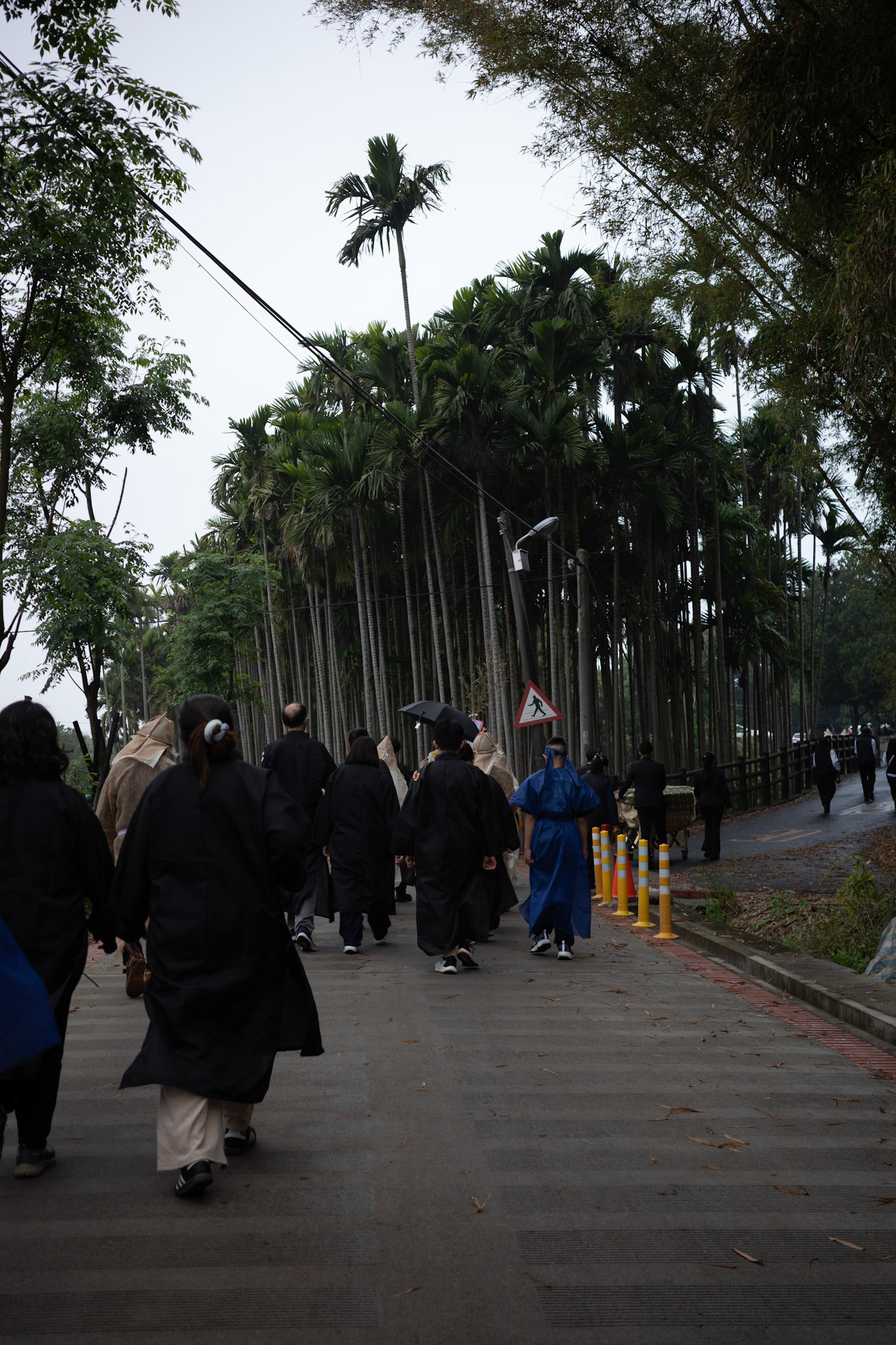
This is the poignant epilogue of our long goodbye: the final funeral procession. Clad in mourning garments that color-code their generations, raw hemp, black, and blue, the family walks slowly behind the hearse, escorting my grandfather away from the home and neighborhood where he spent his entire life. As his physical body turns past the familiar street corner for the last time, a profound memory of that spot overlaps with the present moment. That corner was once my grandfather’s small vegetable garden. I remember, as a child, following closely behind him. Barefoot, pushing a farm-use tricycle, his eyes shone with a proud light as he showed my sister and me the large cabbages he had grown.
Today, the funeral brass band plays "Auld Lang Syne." My most profound memory of this melody traces back to the film The Last Emperor, during the scene where Puyi bids a grand farewell to his Scottish tutor, Reginald Johnston. Introduced to Taiwan during the Japanese colonial era and later adopted by local brass bands (colloquially known as "Si-So-Mi"), this Scottish folk tune has evolved into a quintessential requiem for final farewells in Taiwanese culture. Flanking the road are the towering betel nut trees he planted in his youth, standing now like a silent guard of honor. Amidst the cross-cultural melody of parting and the footsteps of four generations, my grandfather bids his final farewell to the land he cultivated and loved for a century.
[轉角驪歌]
這是漫長告別的最終章:「發引」(出殯)。家屬們身披代表各自世代的麻衣、黑袍與藍衫,緩步跟隨著靈車,護送外公離開他生活了一輩子的家。當外公的肉身緩緩繞過那個最熟悉的街角,我對這首歌的記憶,與眼前的畫面發生了奇妙的重疊。那個轉角,曾是外公的小菜園。我記得小時候跟在他的後面,他赤著腳推著農用三輪車,眼神充滿著光,驕傲地向我和妹妹展示他種的大高麗菜。
今天,送葬樂隊吹奏起了《Auld Lang Syne》,我對這段旋律最深刻的記憶,停留在電影《末代皇帝》中,溥儀送別英籍導師莊士敦時儀隊奏響的驪歌。這首源自蘇格蘭的民謠,在日治時期傳入台灣,並隨著在地銅管樂隊(西索米)的演進,成為了台灣喪葬文化中象徵終極告別的時代安魂曲。道路兩旁高聳的檳榔樹,是外公年輕時親手栽種的根基,如今它們彷彿靜默的儀仗隊,目送著主人離開。在跨越國界的悠揚驪歌與四代子孫的腳步聲中,外公與這片他開墾、眷戀了一世紀的土地,做出了最後的道別
Audio Credit:
This rendition of "Auld Lang Syne," captured by the YouTube channel "映像咖啡顯影," preserves the unique auditory landscape of Taiwanese funeral traditions. Special thanks to the creator for documenting this cultural soundscape.
錄音參考:
這段由 YouTube 頻道「映像咖啡顯影」記錄的《Auld Lang Syne》演奏,還原了台灣葬儀中那份獨特的聽覺地景。感謝創作者對常民文化的珍貴紀錄。
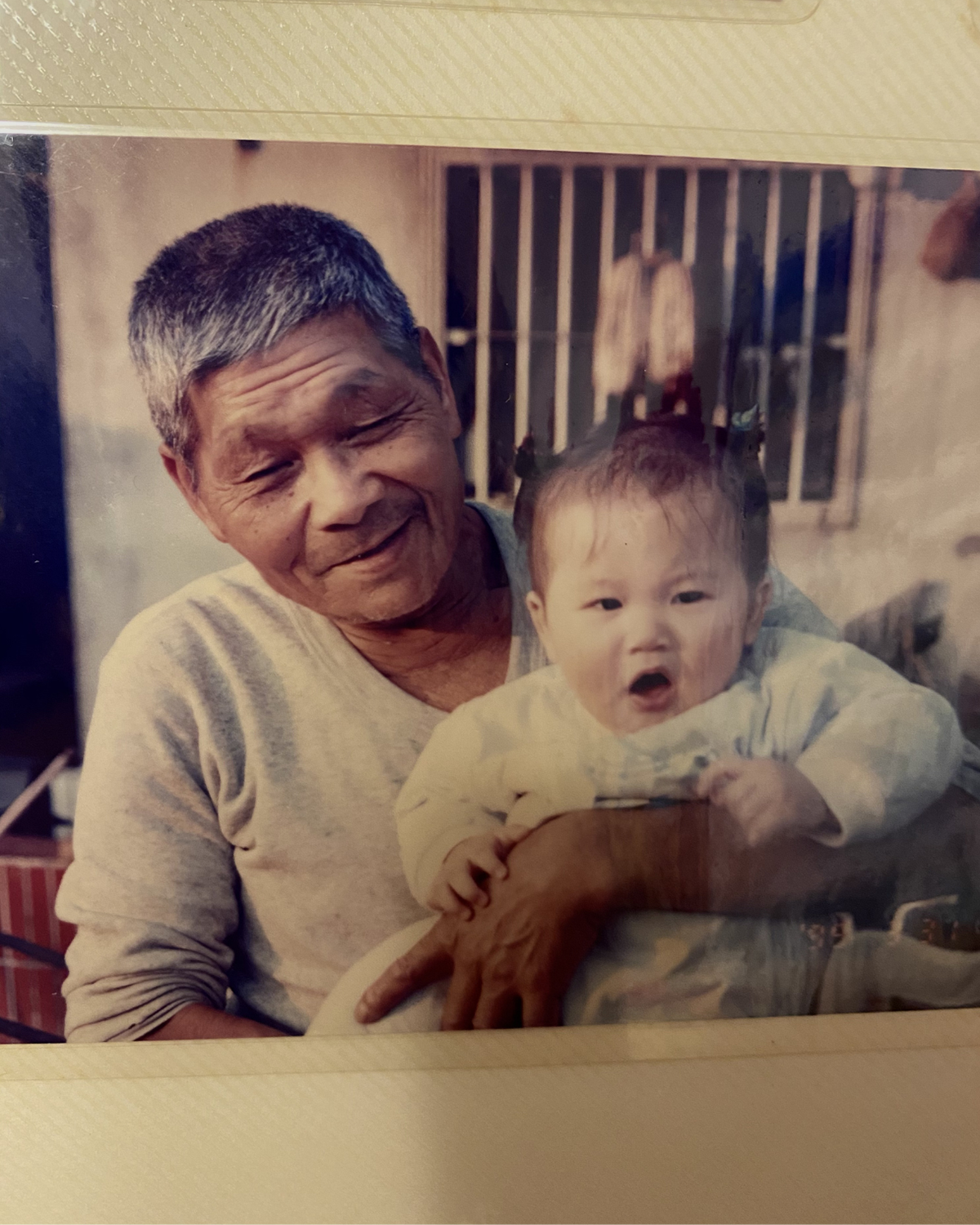
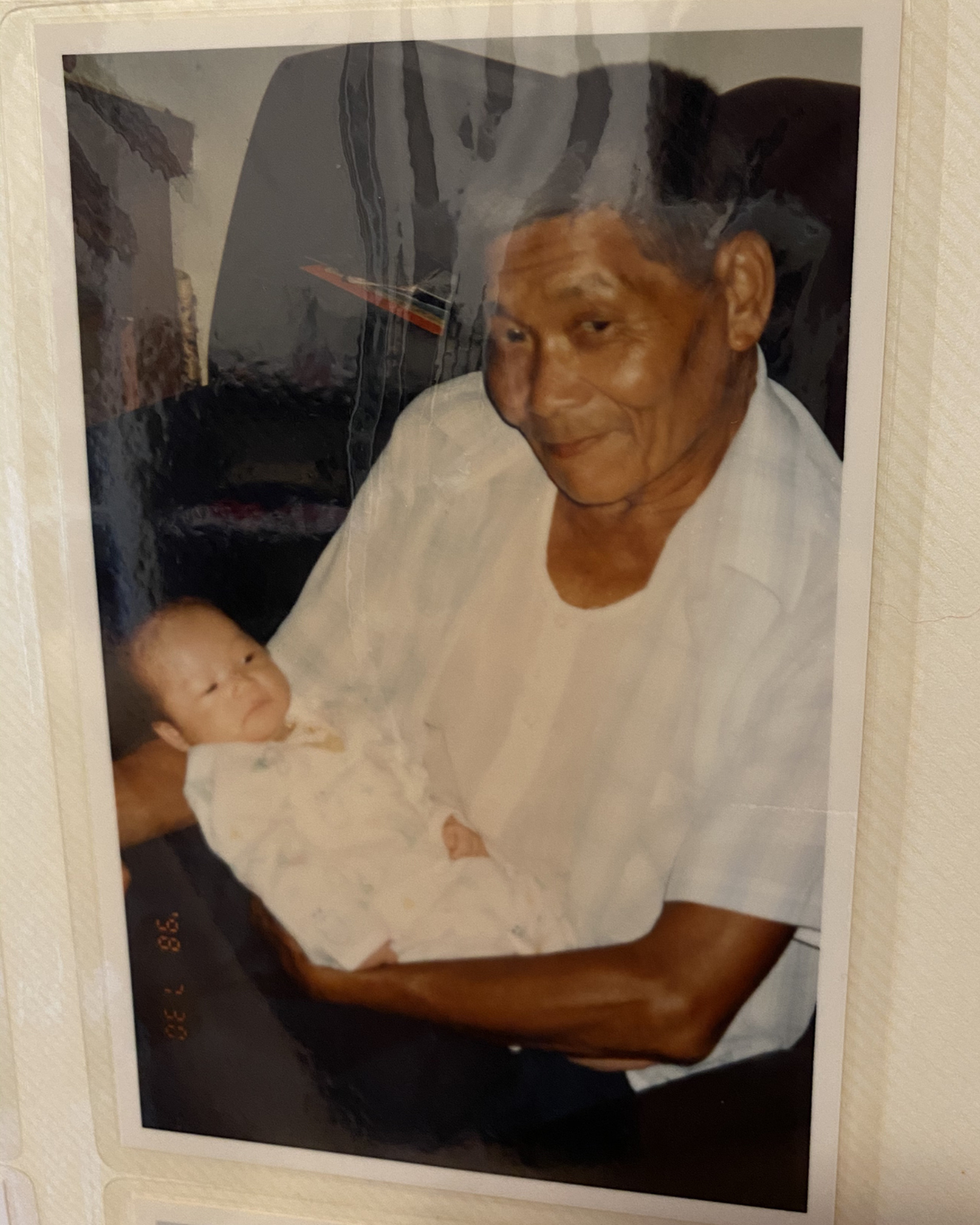
In these photos, my grandfather holds me as an infant with tenderness in his eyes. Long before becoming a revered patriarch surrounded by descendants, he endured a youth full of grueling hardship. To provide for his family, he worked as a timber pond laborer in Keelung Harbor. In an era when labor rights were non-existent, he had to walk atop massive logs floating and rolling on the sea. It was a perilous job; a single slip meant falling into the water where the shifting logs would instantly close up, sealing any hope of surfacing for air. Surviving those treacherous years at the harbor shaped him into a man of unwavering integrity and deep loyalty to his friends. These photos capture the softest side of a resilient life.
這張照片裡,外公抱著嬰兒時期的我,眼神中溢滿了慈愛。在成為子孫滿堂的百歲人瑞之前,外公曾有一段鮮為人知的艱辛歲月。年輕時的他為了撐起家庭,曾在基隆港擔任險峻的貯木勞工。在那個勞權尚未被重視的年代,他必須行走在海面上漂浮且不斷滾動的原木上;那是一份一旦失足,四周原木便會迅速合攏封死求生出口、與死神博弈的工作。經歷過海港拼搏的險惡,讓外公生前極為正直且重視朋友間的義氣。這張合影捕捉了他一生中最溫柔的時刻。
[The Foundation of Soul]
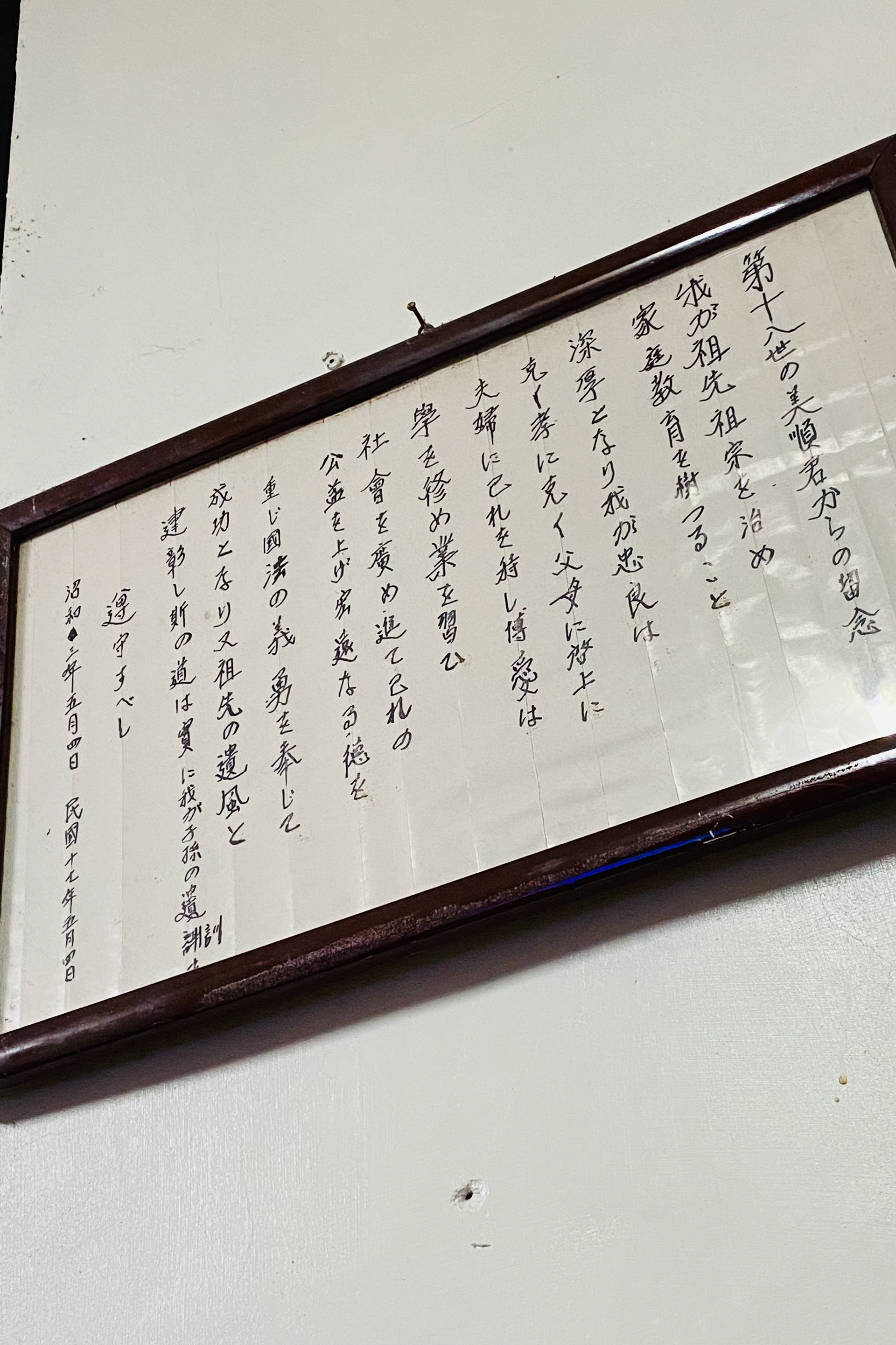
To conclude this collection, I return to the Japanese family motto on the wall of my grandfather’s living room. Far from being a weathered relic, these were life principles he personally transcribed for his descendants with a marker on white paper in his later years. For him, these words were more than just a family code; they were the guidelines of a century-long life. In his writing, he urged future generations to value education, practice filial piety, contribute to the public good, and care for society.
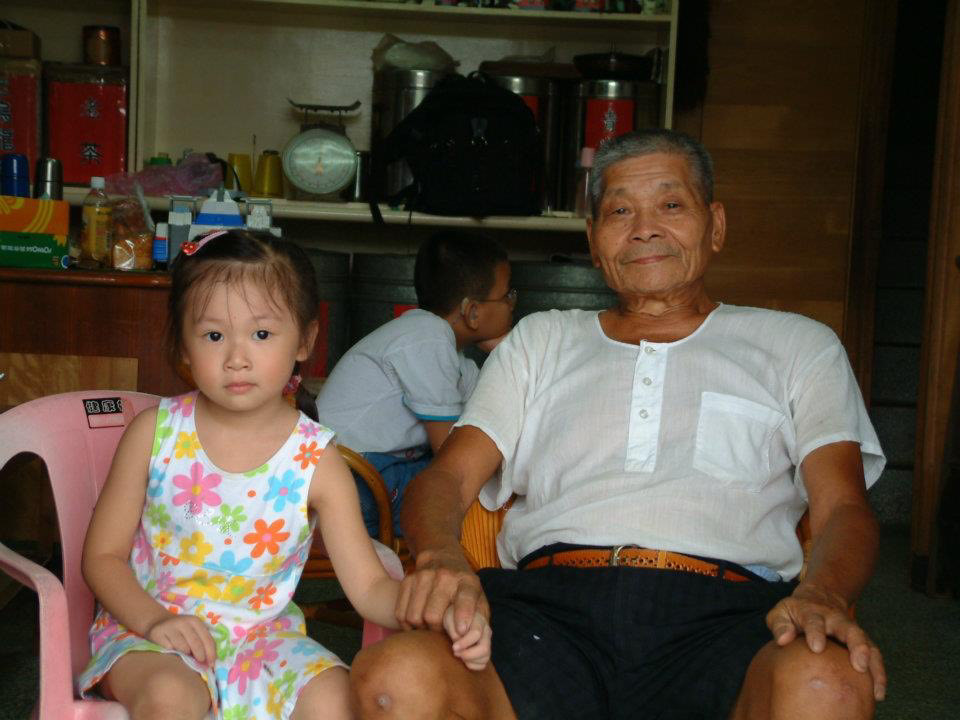
In the photo on the right, my grandfather’s hand, weathered and thick, firmly holds mine as a young child. Ultimately, this "long goodbye" is etched into our bloodline through the strokes of his hand-written ink and the lingering warmth of his palm.
攝影集的最後,我回到了外公客廳牆上的那份日文家訓。這並非斑駁的古蹟,而是外公在晚年親手拿起麥克筆,在白紙上為子孫重新謄寫下的生命準則。對他而言,這些文字不僅是家族規訓,更是他跨越世紀的人生起點與縮影。他在文中教勉子孫要重視教育、克盡孝道、奉獻公益並愛護社會。右圖中,外公那雙經歷過世紀風霜、厚實有力的手,緊緊牽著年幼的我。這場長達一世紀的「長久告別」,最終透過這些手寫的墨跡與掌心的溫度,深深刻入我們的血脈之中。
謹以此系列,獻給我的外公。 一世紀的守護,終成我們生命中永恆的根基。
In loving memory of my grandfather. A century of protection, now the eternal foundation of our lives.